Find Hotels on Elba
Prices can change a lot depending on season, weekends and events.
If you want to compare hotels, apartments and guesthouses:
➡️ Check accommodation options on Elba island on Booking.com
The most important advice is therefore simple: check the timetable before starting your trip and check your return journey at the same time.
This guide explains how to buy bus tickets on Elba, current fares in 2026, the Elba Pass, the main routes, how to read Italian timetables and what travelling on the island’s buses is actually like.
Our quick assessment
Elba can be explored without a car, particularly in summer from Monday to Saturday. However, we would not describe the island as ideal for a car-free holiday. Good planning is essential, and choosing accommodation in Portoferraio can make travelling by bus considerably easier.
Who operates the buses on Elba?
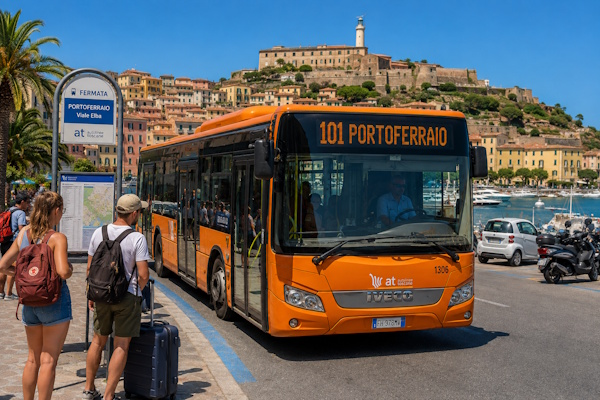
The main public bus network on Elba is operated by Autolinee Toscane, the regional public transport operator for Tuscany.
There are three types of buses that are particularly relevant for visitors:
- Interurban buses connecting Portoferraio with towns and villages around Elba
- Urban buses, particularly around Portoferraio
- Seasonal beach buses and local summer services operating in some tourist areas
For most visitors exploring the island, the interurban network is the most important.
Portoferraio is the main bus hub on Elba
Portoferraio is the most important hub for bus travel on Elba. This is particularly convenient for visitors arriving by ferry from Piombino.
The main bus station is located at the port, close to the ferry terminals. From here, buses depart towards different parts of the island.
Many journeys between different areas of Elba require a change in Portoferraio. This can make travelling between two places relatively time-consuming even though the distances on the island are not particularly large.
For this reason, we consider Portoferraio one of the most practical places to stay on Elba if you do not have a car. Staying in or close to the town can reduce the number of transfers and the amount of time spent waiting for buses.
Tours and activities on Elba
Public buses are a good option for exploring Elba on a budget. For places that are difficult to reach by bus, you can also find boat trips, island tours, kayaking, snorkeling and other activities on Elba.
Where can you buy bus tickets on Elba?
There are several ways to buy bus tickets on Elba. Tourists do not necessarily need to find a ticket office before every journey.
Tickets can be purchased at ticket offices and authorised retailers, through the official at bus app and using contactless payment on buses. There is also an SMS ticket system, although this is of limited use to most international visitors.
1. Buy tickets at the bus station
The traditional option is to buy a ticket before travelling.
Portoferraio has an Autolinee Toscane ticket office at Viale Elba 20. According to the operator’s 2026 service information, the ticket office has longer opening hours during the summer season and is then also open on Sundays and public holidays.
This is particularly useful if you arrive by ferry and want information about your onward journey.
2. Buy tickets from a Tabacchi or authorised retailer
Tickets are also available from authorised sales points around the island. These include many Tabacchi, the traditional Italian tobacco shops that sell much more than cigarettes.
For tourists staying outside Portoferraio, these retailers can be an easy way to buy a paper ticket without travelling to the main bus station.
If you buy a traditional paper ticket, remember to validate it according to the applicable rules when starting your journey.
3. Pay contactless directly on the bus
For many foreign visitors, contactless payment is probably the easiest way to pay for an individual bus journey on Elba.
Modern contactless readers are installed on buses. You can use a compatible bank card, smartphone or digital wallet without registering for an account or buying a paper ticket beforehand.
On interurban journeys, it is particularly important to use the same card or device when entering and leaving the bus so that the system can calculate the correct fare for the distance travelled.
Important
When using contactless payment on an interurban bus, remember to tap with the same card or device when required at the beginning and end of your journey. Do not use your physical bank card when boarding and the same card through Apple Pay or Google Pay when leaving, as the system may recognise these as different payment methods.
4. The at bus app
The official at bus app is another useful option, especially if you intend to use public transport regularly during your holiday.
The app can be used to search for connections and stops, check departures and buy tickets. Real-time information is also available for supported services.
For visitors without a car, installing the app before travelling to Elba is useful even if you eventually decide to pay for individual journeys by contactless card.
5. SMS tickets are not very useful for foreign tourists
Autolinee Toscane also offers tickets by SMS, but there is an important limitation for international visitors.
The service works through supported Italian mobile networks, with the ticket price charged through the mobile operator. A visitor travelling with a normal foreign SIM card therefore cannot generally rely on the SMS ticket system.
For most international tourists, the app, contactless payment or a conventional ticket from a sales point are much more practical.
Can you buy a ticket from the bus driver?
We recommend not relying on the driver to buy your ticket.
Autolinee Toscane does provide for on-board ticket sales by drivers under certain conditions, but availability is not guaranteed, a surcharge can apply and change may not be available.
On Elba there are now enough alternatives that tourists normally have little reason to depend on this option. Contactless payment on the bus is much easier if you have not purchased a ticket in advance.
Bus ticket prices on Elba in 2026
Bus travel on Elba is, in our opinion, relatively inexpensive.
Interurban fares are based on the distance travelled. Since 1 August 2026, the standard Autolinee Toscane interurban fares start at just over €2 for short journeys.
| Distance | 2026 fare |
|---|---|
| Up to 10 km | €2.20 |
| 10.1–20 km | €3.80 |
| 20.1–30 km | €5.10 |
| 30.1–40 km | €6.50 |
| 40.1–50 km | €8.10 |
Considering the cost of taxis and rental cars on a holiday island, we find these fares reasonable. Even a relatively long bus journey across Elba costs only a few euros.
Visitors should nevertheless check the current fare before travelling, particularly if reading this guide after 2026, as public transport prices can change.
Elba Pass: Unlimited bus travel for tourists
Visitors planning several bus journeys should consider the Elba Pass.
The pass is designed specifically for travel on the island and is available for different periods.
| Elba Pass | 2026 price |
|---|---|
| 1 day | €11.10 |
| 3 days | €16.60 |
| 6 days | €27.60 |
The three-day pass is particularly interesting for visitors planning several excursions. At €16.60, it can quickly become worthwhile if you make a number of longer return journeys.
The six-day pass costs only €4.60 per day when used for the full period. For a visitor spending most of a week on Elba without a car, this can represent good value.
How many main bus routes are there on Elba?
The network changes between summer and winter, which initially makes the Elba bus system look more complicated than it really is.
For tourists, a simple way of understanding it is that there are four important interurban routes during the summer season and a reduced network centred on three principal routes during the winter period.
In summer, the most relevant interurban lines are 117, 120, 121 and 222.
Bus 117: Portoferraio – Porto Azzurro – Rio – Cavo
Line 117 serves the eastern side of Elba and is one of the island’s most important bus routes.
It connects Portoferraio with Porto Azzurro, Rio nell’Elba, Rio Marina and Cavo, with services also relevant for the Capoliveri area.
This is the main route to look at if you are staying in Portoferraio and want to explore eastern Elba without a car.
Bus 120: Portoferraio – Marina di Campo – Pomonte
Line 120 runs from Portoferraio towards Marina di Campo and continues along the southern and western part of the island towards Pomonte.
Marina di Campo is one of Elba’s main tourist resorts and has one of the island’s best-known sandy beaches, making this an important summer route for visitors.
Bus 121: Portoferraio – Marciana Marina – Marciana – Pomonte
Line 121 approaches western Elba from the northern side.
It connects Portoferraio with Marciana Marina, Marciana and Pomonte.
The 2026 summer timetable illustrates how good some of the main summer services can be. On line 121, departures from Portoferraio are scheduled approximately hourly for much of the day during the main summer timetable. However, this level of frequency should not be assumed for every route on the island.
Bus 222: Portoferraio – Lacona
Line 222 provides a summer connection between Portoferraio and Lacona.
Lacona is particularly interesting for beach visitors, so this route is useful for tourists staying in Portoferraio without their own transport.
Find Hotels on Elba
Prices can change a lot depending on season, weekends and events.
If you want to compare hotels, apartments and guesthouses:
➡️ Check accommodation options on Elba island on Booking.com
Bus services are much better in summer
The difference between summer and winter is significant.
During the main tourist season, some important routes operate approximately once an hour. Other services may operate only around every two hours.
In winter, the network is reduced considerably. Some destinations may have only a few useful connections during the day.
This means that the answer to the question “Is public transport good on Elba?” depends strongly on when you visit.
In summer, particularly from Monday to Saturday, the network is reasonably useful. In winter it requires considerably more planning.
Check the timetable before every longer trip
Even during summer, we recommend planning excursions around the bus timetable rather than simply going to a bus stop and waiting.
A two-hour gap between buses is not unusual on some routes. Missing a departure can therefore mean losing a substantial part of your day.
Always check three things before leaving:
- the outward journey;
- the return journey;
- the last realistic bus you can use if your plans change.
This is particularly important when visiting smaller villages or beaches.
Understanding Italian bus timetables: Feriale and Festivo
One potential source of confusion is the language used on Italian bus timetables.
Some timetables are primarily or entirely in Italian. Two words are particularly important:
Feriale – normally refers to working days and frequently includes Saturday.
Festivo – refers to Sundays and public holidays.
English-speaking visitors should therefore not automatically interpret “feriale” as Monday to Friday.
Important timetable tip
On Italian timetables, “Feriale” commonly includes Saturday, while “Festivo” means Sundays and public holidays. Some individual journeys can have additional restrictions, so always check the notes printed on the timetable.
Sunday is not the best day for exploring Elba by bus
From our experience, Sunday is generally the least convenient day for a long sightseeing trip by bus.
There are usually fewer services than from Monday to Saturday, and a route that is relatively easy to use on a weekday can become much less practical on Sunday.
If you have several days on Elba, we recommend using Monday to Saturday for longer bus excursions and keeping Sunday for destinations close to your accommodation.
Are buses on Elba punctual?
Our experience with reliability has generally been acceptable. Most scheduled buses operate, but delays can occur, particularly during the busy summer months.
The reason becomes obvious when travelling around Elba. Many of the island’s roads are narrow and winding. During July and August they also carry a large amount of tourist traffic.
A bus caught behind slow traffic has few opportunities to make up lost time.
We therefore recommend allowing extra time if you need to make an important connection.
This is particularly important when travelling back to Portoferraio to catch a ferry. We would not plan a bus journey that is scheduled to arrive only a few minutes before ferry check-in.
What are the buses on Elba like?
The buses themselves are generally fine for the relatively short journeys around the island.
Most of the buses we used had air conditioning, which is important during the hot Elba summer. However, passengers should not expect Wi-Fi.
Comfort depends much more on how busy the bus is.
During the main summer season, popular services can become crowded. Local beach buses can be particularly busy at peak times when large numbers of people travel to or return from the beaches.
Try to get a seat on longer journeys
A standing journey on Elba can be surprisingly tiring.
The island has numerous bends, steep sections and narrow roads. Standing in a crowded bus while it repeatedly accelerates, brakes and negotiates curves is considerably less comfortable than standing on a normal city bus.
If you are travelling a longer distance, getting a seat makes a significant difference.
Beach buses and summer services on Elba
In addition to the main interurban network, there are seasonal local buses serving beaches and tourist areas.
These services are particularly useful because they can operate more frequently than some of the regular interurban routes.
Portoferraio, for example, has summer urban routes serving beaches and coastal areas. The 2026 network includes seasonal connections towards places such as Viticcio, Bagnaia and Biodola, as well as a summer route serving beaches including Le Ghiaie, Capobianco and Acquaviva.
Other municipalities can operate their own seasonal services, often referred to as Marebus.
These are worth checking locally because routes and operating periods can change from one summer season to another.
The disadvantage is popularity. In our experience, beach buses can become extremely crowded at peak times.
Urban buses in Portoferraio
Portoferraio also has a separate network of urban bus routes.
We have not personally used these buses, so we cannot comment on their comfort or reliability from our own experience.
However, they can be useful for visitors staying in Portoferraio. The 2026 urban network includes connections within the town as well as services towards San Giovanni, San Martino, Viticcio, Bagnaia, Biodola and several nearby beaches.
The main departure point is again conveniently located around the port and bus station area.
Do you have to signal the bus to stop?
Yes. Autolinee Toscane advises passengers waiting at a stop to raise a hand clearly to indicate that they want to board.
Once on the bus, press the stop button in advance when approaching your destination.
This is worth remembering at quieter stops. Do not assume that a bus will automatically stop if nobody appears to be waiting to board and nobody on board has requested the stop.
Luggage on buses on Elba
Travelling with luggage is generally possible, which is important for passengers arriving on Elba by ferry without a car.
Small luggage can be carried on board within the operator’s size and weight limits. Larger interurban buses also have luggage compartments underneath the passenger area.
We have found this practical when travelling with normal holiday luggage.
There is, however, an important detail in the official rules. Autolinee Toscane allows one piece of luggage up to a total combined dimension of 105 cm and 10 kg free of charge. Larger luggage up to the specified maximum limits can be carried in the luggage compartment where available, but an additional fare may officially apply.
Loading and unloading also depends on the type of stop and the driver’s instructions. At terminal stops, luggage-compartment loading is carried out under the driver’s supervision. :contentReference[oaicite:0]{index=0}
Can you take a bicycle on an Elba bus?
Bicycle transport is more complicated than luggage transport.
A folding bicycle is the easiest option. On urban services, folded bicycles can be accepted within the operator’s dimensional rules, provided they do not obstruct passengers or doors.
There is an important correction to a common assumption, however: the current Autolinee Toscane rules do not completely prohibit normal bicycles on all interurban buses. An unfolded bicycle may be carried in the luggage compartment of a suitable bus if space is available, subject to the applicable conditions and fare. Transport can also be refused when the bus is crowded. :contentReference[oaicite:1]{index=1}
For a tourist, we would therefore not rely on being able to take a normal bicycle on a particular bus. If combining cycling with public transport is essential to your plans, check the specific service beforehand.
What about beach equipment?
In our experience, drivers are generally pragmatic about reasonable holiday equipment. Taking something such as a normal beach umbrella has not been a problem for us.
Common sense is important, particularly on crowded summer buses. Avoid bringing large or bulky items that obstruct the aisle, doors or other passengers.
Can you visit Elba without a car?
Yes, but we would not call it easy.
This is probably the most important conclusion for anyone considering a car-free holiday on Elba.
During summer, particularly from Monday to Saturday, the bus network makes it possible to reach many of the island’s principal towns and several beaches.
The problem is time.
A journey that is straightforward by car may require waiting for a bus, travelling to Portoferraio, changing buses and then waiting for another connection. If services operate every two hours, poor planning can consume a substantial part of the day.
Possible summer delays make tight connections even less attractive.
In winter and on Sundays, the reduced frequency makes exploring the whole island by bus considerably more difficult.
Where should you stay on Elba without a car?
If we were planning a holiday on Elba relying mainly on public transport, Portoferraio would be our first choice as a base.
The reason is not necessarily that it is the most beautiful resort on the island. It is simply the most practical location for the bus network.
Many routes start or connect in Portoferraio, and journeys between different parts of Elba frequently involve changing buses there.
Staying in the town can therefore save considerable travelling and waiting time.
It is also convenient on arrival and departure days because the main bus station is close to the ferry port.
For visitors travelling without a car, choosing the right accommodation can be almost as important as understanding the bus timetable.
In Part 2 we look in more detail at travelling around Elba without a car, useful bus excursions, beach connections, journey planning and practical tips for making the most of the island’s public transport.
Getting around Elba by bus: What works well and what does not?
Elba’s bus network is useful, but it is important to have realistic expectations. The island is not a destination where you can usually walk to a bus stop without checking the timetable and expect another bus within a few minutes.
During the summer season, the main routes are considerably more useful. Some connections operate approximately hourly for parts of the day, while others have gaps of around two hours. This makes it possible to visit many of Elba’s main towns and beaches without a car, provided that you plan ahead.
Our main recommendation is to plan the entire excursion before leaving. Do not check only the outward bus. Look at the return connections as well, particularly the last two realistic buses of the day.
If you miss a bus on a route with a two-hour interval, a simple day trip can suddenly involve a very long wait.
Best time of year for travelling around Elba by bus
For visitors relying heavily on public transport, summer is clearly the best season. The network is expanded for the tourist season, and additional local and beach services operate in several areas.
From Monday to Saturday, it is possible to organise quite a few useful excursions. The situation becomes more difficult on Sundays, public holidays and outside the main tourist season.
In winter, some routes have only a handful of useful departures per day. Public transport can still be used, but spontaneous sightseeing becomes much more difficult.
Monday to Saturday is better than Sunday
If you have a choice, we recommend planning your most important bus excursions between Monday and Saturday.
Sunday services are generally considerably more limited. This does not mean that there are no buses, but the gaps between departures can make some excursions impractical.
A good strategy for a one-week holiday is therefore to use weekdays and Saturday for destinations farther from your accommodation and keep Sunday for the beach, Portoferraio or another destination that is easy to reach.
How to plan a bus excursion on Elba
Planning a bus journey on Elba is not particularly difficult, but there are a few things we recommend checking.
- Find the correct bus for your destination.
- Check whether you are looking at a summer or winter timetable.
- Check whether the departure is marked Feriale or Festivo.
- Find a suitable return bus before starting your trip.
- Allow some extra time for possible traffic delays.
- If you have to change in Portoferraio, avoid very tight connections.
The official at bus app makes this considerably easier than trying to understand several printed timetable tables.
Allow extra time when catching a ferry
One situation where we would be particularly cautious is travelling by bus to Portoferraio for a ferry departure.
Traffic can be heavy during the main summer season. Elba also has many narrow and winding roads, and buses cannot simply overtake slow-moving traffic everywhere.
Consequently, a bus can accumulate a delay during a longer journey.
If you need to catch a ferry to Piombino, do not choose a connection that theoretically arrives only shortly before your required check-in time. Taking an earlier bus is the safer option.
Portoferraio bus station and ferry port
One of the advantages of public transport on Elba is the location of the main bus station in Portoferraio.
The bus station is close to the ferry terminals, so visitors arriving as foot passengers can continue their journey without needing a taxi simply to reach the main public transport hub.
This is also one reason why Portoferraio is such a convenient base for a holiday without a car.
If you stay elsewhere, you may find yourself travelling back to Portoferraio repeatedly because many of the island’s main routes converge there.
Can you travel from Portoferraio to Marina di Campo by bus?
Yes. Marina di Campo is one of the most important destinations that can be reached by bus from Portoferraio.
During the summer timetable, line 120 serves the route towards Marina di Campo and continues towards the western part of Elba.
Marina di Campo is particularly suitable for a bus excursion because the town itself and its long sandy beach are close together. You do not necessarily need additional transport after arriving.
This makes Marina di Campo one of the easier destinations for visitors staying in Portoferraio without a car.
Can you travel to Marciana Marina by bus?
Yes. Marciana Marina is served from Portoferraio by the route running around the northern side of western Elba.
This is another destination that works reasonably well for a day trip because the centre, waterfront and harbour are compact.
The journey itself is also interesting. The roads in western Elba are often winding and offer very different scenery from the more developed area around Portoferraio.
However, this is exactly the type of journey where getting a seat is preferable. Standing for a long period on a bus travelling around numerous bends can become tiring.
Porto Azzurro by bus
Porto Azzurro is one of the most useful destinations on the eastern bus route.
The town is compact and can easily be explored on foot after arriving. Restaurants, the waterfront and the central areas are all relatively close together.
For travellers without a car, places like Porto Azzurro have an advantage over remote beaches: once you arrive, you do not need another form of transport to see the main sights.
Rio Marina and Cavo by bus
The eastern route also continues towards Rio Marina and Cavo.
This makes it possible to explore a considerable part of eastern Elba using public transport.
However, the farther you travel from Portoferraio, the more important the return timetable becomes. A missed connection is much less problematic in Portoferraio than at the far end of the island late in the afternoon.
Capoliveri by bus
Capoliveri can also be reached using public transport, although visitors should pay particular attention to the exact route and timetable for their date of travel.
The historic hilltop town is one of the most popular destinations on Elba and is well worth considering for a bus excursion.
Local summer transport in the municipality can also be useful for reaching beaches that would otherwise be difficult to visit without a car.
Visiting beaches on Elba by bus
Reaching beaches is one of the more complicated aspects of exploring Elba without a car.
Some beaches are served very well, particularly during the summer. Others are far from the main interurban routes or require a substantial walk from the nearest stop.
This is why the seasonal beach buses are so useful.
Different municipalities operate additional summer connections between tourist centres, parking areas and popular beaches. These services are sometimes called Marebus.
They should be considered separately from the four main summer interurban routes.
Marebus and local beach buses
The exact Marebus network can change between seasons, so visitors should always check the current year’s information rather than relying on an old timetable found online.
In 2026, local summer services are again an important part of public transport in several tourist areas of Elba.
These buses can have one major advantage over the normal interurban network: they may operate much more frequently.
For someone staying in the right area, a local beach bus can therefore be far more convenient than using a car and searching for parking close to a popular beach.
The disadvantage: crowded buses
There is also a downside.
From our experience, the beach buses can become extremely crowded during peak periods in summer.
The busiest times are predictable: late morning when large numbers of visitors are travelling to the beach and later in the afternoon when many people want to return at approximately the same time.
If you can travel outside these peak periods, the journey is generally more comfortable.
Portoferraio beach buses
Portoferraio has seasonal services connecting the town with several beaches and coastal areas.
Depending on the current summer timetable, these can include connections towards beaches and areas such as Le Ghiaie, Capobianco, Acquaviva, Viticcio and Biodola.
This makes Portoferraio more attractive as a base for visitors without a car. You can use the main interurban network for longer excursions and local services for some beach trips.
Always check the current timetable because seasonal routes, operating dates and frequencies can change.
Is Elba suitable for a completely car-free holiday?
It depends strongly on what you want to do.
If your priority is visiting the main towns, spending time at a few well-connected beaches and taking occasional day trips, a holiday without a car is certainly possible.
If you want to explore remote coves, small mountain villages and different parts of the island every day, a car gives you considerably more freedom.
Elba is not a huge island, but public transport journeys do not always follow the shortest possible route. Changing buses in Portoferraio can turn a relatively short geographical distance into a much longer journey.
Who can manage well without a car?
We think the bus network works best for visitors who:
- stay in Portoferraio or another well-connected town;
- visit during the summer season;
- travel mainly from Monday to Saturday;
- are willing to plan excursions in advance;
- do not need to visit several remote places on the same day;
- are happy to combine bus travel with walking.
Who should consider renting a car?
A rental car is more useful if you want maximum flexibility, particularly for remote beaches and smaller villages.
It is also useful if your accommodation is outside one of the main settlements or far from a useful bus route.
Families carrying a lot of beach equipment may also find a car easier, particularly when travelling with young children.
However, a car has disadvantages as well. Parking close to popular beaches can be difficult during the busiest weeks of summer, and driving on Elba’s narrow roads is not enjoyable for everyone.
Bus or rental car on Elba?
| Bus | Rental car |
|---|---|
| Relatively inexpensive | Considerably more expensive |
| No parking problems | Parking can be difficult at popular beaches |
| Good for several main towns | Good for almost every part of the island |
| Requires timetable planning | Much more flexible |
| Waiting times can be long | Little waiting |
| Sunday and winter services limited | Independent of bus schedules |
| No need to drive on narrow roads | Narrow and winding roads require concentration |
For a short summer holiday based in Portoferraio, we would not consider a rental car essential. For an intensive tour of the entire island, however, a car saves a considerable amount of time.
Combining buses with walking
One of the best ways to use public transport on Elba is to combine it with walking.
You do not necessarily need a bus stop directly in front of every attraction. If a beach or village is within reasonable walking distance of a main route, the bus can still be useful.
However, remember that Elba is hilly. A distance that looks short on a map can involve a significant climb.
Summer temperatures are another consideration. Walking several kilometres in July or August is very different from doing the same walk in April or October.
Bus travel with luggage after arriving by ferry
Elba is particularly suitable for arriving as a foot passenger on the ferry because the Portoferraio bus station is close to the port.
If your accommodation is located on one of the main bus routes, it may therefore be possible to travel from mainland Italy to your hotel entirely by public transport.
The larger interurban buses generally have luggage compartments, making them much more suitable for passengers with suitcases than a small urban bus.
We recommend checking the location of your accommodation carefully before booking. A hotel described as being “near” a village may still be some distance from the bus stop, particularly in hilly areas.
Find Hotels on Elba
Prices can change a lot depending on season, weekends and events.
If you want to compare hotels, apartments and guesthouses:
➡️ Check accommodation options on Elba island on Booking.com
Travelling on Elba buses with reduced mobility
Accessibility depends on the bus, route and stop.
Modern buses can offer accessibility features, but the island itself creates additional difficulties. Some stops are located along narrow roads, pavements are not always available and older villages can have steep streets.
Passengers who require step-free access should therefore check the particular journey rather than assuming that every route and stop is equally accessible.
Standing on a crowded bus is also difficult for anyone with reduced mobility because of Elba’s winding roads. If possible, travelling outside the busiest beach-bus periods increases the chance of finding a seat.
Our practical tips for using buses on Elba
- Use the at bus app. It makes finding connections easier than relying entirely on printed Italian timetables.
- Check the return journey before leaving. This is probably our most important tip.
- Remember Feriale and Festivo. Feriale commonly includes Saturday; Festivo means Sundays and public holidays.
- Avoid Sunday for complicated excursions. There are generally fewer buses.
- Allow time for delays. Heavy summer traffic and narrow roads can affect journey times.
- Try to get a seat. Standing on a winding Elba road for a long journey can be tiring.
- Consider contactless payment. For occasional journeys it is one of the simplest ticket options.
- Check local beach buses. They can be much more frequent than the normal interurban network.
- Do not rely on buying a ticket from the driver. Use contactless payment, the app or buy your ticket beforehand.
- Choose your accommodation carefully. Portoferraio is particularly convenient for visitors relying on buses.
Frequently asked questions about buses on Elba
Does Elba have public buses?
Yes. Elba has an extensive public bus network operated mainly by Autolinee Toscane. Interurban routes connect Portoferraio with many of the island’s principal towns, while urban and seasonal beach buses provide additional local connections.
Are buses on Elba expensive?
No. We consider public transport on Elba relatively inexpensive. Standard interurban fares in 2026 start at €2.20, with the price increasing according to distance. Visitors making many journeys can consider an Elba Pass.
Can I pay by card on buses on Elba?
Yes. Contactless payment is available on Autolinee Toscane buses. A compatible bank card, smartphone or digital wallet can be used. On interurban journeys, make sure you follow the tap-on and tap-off procedure using the same card or device.
Can I buy a bus ticket from the driver?
On-board sales by the driver are possible under certain conditions, but we would not rely on this method. Availability is not guaranteed and a surcharge can apply. Contactless payment is a much easier solution if you board without a paper or app ticket.
Is there a bus app for Elba?
Yes. The official at bus app from Autolinee Toscane can be used to search for routes and stops, check departures and buy tickets.
Is there a tourist bus pass for Elba?
Yes. The Elba Pass is available for one, three or six days. In 2026 the prices are €11.10, €16.60 and €27.60 respectively.
Can I travel around Elba without a car?
Yes, particularly during summer, but careful planning is necessary. Some routes run approximately hourly, while others have gaps of around two hours. Sunday and winter services are considerably more limited.
Where is the main bus station on Elba?
The main transport hub is in Portoferraio close to the ferry port. This makes transferring from ferries arriving from Piombino relatively straightforward.
Are there buses to the beaches on Elba?
Yes. Some beaches are served by regular routes, while additional local beach buses and Marebus services operate in several areas during summer. These seasonal services can be relatively frequent but may become very crowded at peak times.
Do buses run on Sundays on Elba?
Yes, but services are generally much less frequent. Look for the Festivo timetable, which applies to Sundays and public holidays. We recommend arranging longer bus excursions from Monday to Saturday whenever possible.
Do buses run in winter on Elba?
Yes, but the network and frequencies are reduced. Some routes have only a few useful departures per day. The summer network is much better suited to sightseeing.
Are buses on Elba air-conditioned?
Most of the buses we have used were air-conditioned. This is particularly important during July and August. However, buses can still become uncomfortable when they are very crowded.
Do buses on Elba have Wi-Fi?
Do not expect Wi-Fi on Elba’s normal public buses. Travellers who need internet access for maps, tickets and timetables should use their own mobile data connection.
Can I take luggage on an Elba bus?
Yes. Luggage is permitted subject to the operator’s size and weight rules, and larger interurban buses usually have a luggage compartment. Check the current conditions for large or unusually heavy items, as an additional fare can apply.
Can I take a bicycle on the bus?
Folding bicycles are the easiest option. Current Autolinee Toscane rules also allow conventional bicycles under certain conditions on suitable interurban buses when they can be carried in the luggage compartment and sufficient space is available. We would not plan an excursion that depends on a normal bicycle definitely being accepted.
Are Elba buses reliable?
Generally yes, but delays are possible. Summer traffic combined with narrow and winding roads can slow buses down. Leave extra time when making an important connection, particularly when catching a ferry.
Our verdict: Are buses on Elba good?
Elba’s buses are better than visitors might expect from a relatively small Mediterranean island, but they do not provide the flexibility of a car.
The biggest advantages are the low fares, useful connections between the main towns and the expanded summer network. Contactless payment has also made using the buses considerably easier for foreign visitors.
The disadvantages are frequency and journey time. Some summer routes operate approximately hourly, but others have gaps of around two hours. Services are reduced significantly on Sundays and during winter.
Delays can also occur. This is understandable when you see Elba’s road network: many roads are narrow, winding and extremely busy during the summer holidays.
For us, the best conditions for exploring Elba by bus are during summer from Monday to Saturday. Plan your journeys in advance, check the return timetable and avoid very tight connections.
We would not describe Elba as an ideal island for travelling entirely without a car. Nevertheless, it is certainly possible.
If you stay in Portoferraio, use the main bus routes and local beach services intelligently and accept that some journeys take longer, you can see a substantial part of Elba without renting a car.
For visitors travelling on a limited budget, the buses are particularly attractive. Even longer journeys cost relatively little, while the multi-day Elba Pass can make regular bus travel even cheaper.
Our final recommendation is therefore simple: use the buses if you have time; rent a car if flexibility is more important.