The façade of Florence Cathedral, officially the Cathedral of Santa Maria del Fiore, is one of the most recognisable sights in the city. Its white, green and pink marble gives the front of the building a richly patterned appearance, and its position beside the Baptistery and Giotto’s Bell Tower makes the cathedral complex a natural focus for visitors. The façade is also much newer than many people expect: the present design was built in the nineteenth century.
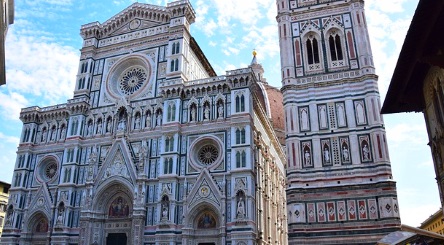
This guide explains the history, materials and details of the façade, how to see it as part of the cathedral square, and what visitors should know about entry and tickets. The cathedral’s exterior can be admired without buying a ticket. Access to the dome, bell tower, baptistery and museum follows separate rules and may require a timed or combined ticket.
Where to see the façade
The cathedral stands in Piazza del Duomo in the historic centre of Florence. The square is within walking distance of the city’s main railway station, although the route is busy and includes pedestrian areas. The façade faces west, towards the Baptistery of San Giovanni. Giotto’s Bell Tower stands beside the cathedral, while the dome rises above the eastern end of the building. These monuments together form one of Florence’s most important architectural groups.
The square is open to the public, so visitors can walk around the exterior and view the façade without entering the cathedral. It can be crowded during the middle of the day. Early morning and later afternoon often provide a calmer experience, though tour groups and events may affect access at any time. The area is heavily pedestrianised; follow signs, respect barriers and avoid stopping in narrow circulation routes for photographs.
Compare Florence Duomo tickets and tours
Review what each offer includes before booking. Check whether the selected option covers the dome climb, the museum or other monuments, and confirm the meeting point and time slot.
A nineteenth-century façade for a medieval cathedral
Florence Cathedral was built over several centuries. Its present façade, however, is not medieval. The earlier medieval front was left unfinished and eventually removed in the sixteenth century. The cathedral then stood without the finished façade seen today for a long period. Various proposals were discussed, but the final design was selected only in the nineteenth century.
Architect Emilio De Fabris was chosen to lead the project. Construction of the current façade began in 1876. De Fabris died in 1883, and his successor Luigi Del Moro completed the work. The façade was inaugurated on 12 May 1887. The large bronze doors were installed later, and the overall façade ensemble continued to be completed into the early twentieth century. This chronology explains why the exterior can look harmonious with the medieval cathedral while belonging to a much later architectural period.
The design is neo-Gothic, drawing on medieval forms while expressing the artistic and civic ideas of nineteenth-century Florence. The sculptural and mosaic programme includes Christian themes and references to the city. The result is not a simple reconstruction of an earlier façade but a deliberate modern interpretation of Florence’s religious and cultural identity.
The colours and marble
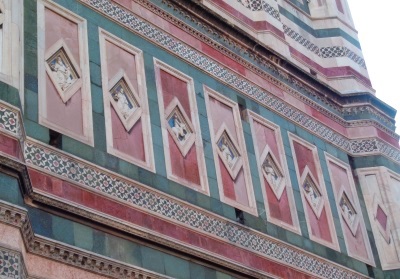
The façade is clad in coloured marble rather than painted. White, green and pink-red stone form geometric patterns, framing portals, windows, statues and decorative bands. These colours continue the visual language seen on the cathedral’s exterior and on nearby buildings, especially the Baptistery and bell tower, but the individual buildings were designed and decorated in different periods.
White marble is associated with the quarries around Carrara, north of Florence. Green marble is traditionally linked with Prato, while pink or red tones are associated with quarries in Tuscany, including the area around Siena. Stone sourcing and historical descriptions can be more complicated than a simple one-colour, one-quarry explanation, and restorations may use replacement materials. The overall effect is what most visitors notice first: contrasting bands and panels that make the façade legible from across the square.
Details to look for
The three portals
The façade is organised around three main portals. Their sculptural decoration and surrounding marble work draw the eye towards the central entrance. Visitors can look for carved figures, decorative frames and differences in the patterns around each doorway. The portals are also practical entrances to the cathedral, so access may be managed by queues and security staff. Keep the route clear and follow instructions at the doors.
Rose window and mosaics
Above the central portal is a large circular window, set into the elaborate composition of the upper façade. Mosaics and sculptural details add colour and narrative elements. From directly below, it can be difficult to take in the whole arrangement; standing further back across the square gives a better sense of how the central axis relates to the side sections.
Statues and symbolic programme
Figures of religious and historical significance are distributed across the façade. The iconographic programme was developed with input from the philosopher Augusto Conti and celebrated the Virgin Mary, Christ and Florence’s religious and civic history. A casual visitor does not need to identify every figure to appreciate the composition, but a guided tour or a museum visit can provide context for the individual sculptures.
Compare the adjoining buildings
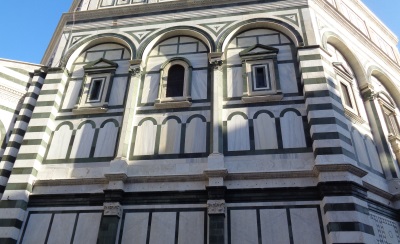
The Baptistery in front of the cathedral is much older, while the bell tower was designed in the fourteenth century. Their façades share the use of coloured stone but differ in proportions, detail and historical style. Looking across the square from one building to another is a useful way to understand that Piazza del Duomo is an ensemble developed over centuries, not a single construction project.
Visiting the cathedral and the monuments
Viewing the façade from the square is free. Entry to the cathedral itself is also generally free, but visitors pass through security and may have to queue. Rules, opening hours and access can change for worship, events or conservation work, so check the official Opera di Santa Maria del Fiore visitor information before travelling. Dress respectfully for a place of worship; shoulders and knees should be covered.
The dome climb, Giotto’s Bell Tower, the Baptistery and the Opera del Duomo Museum are separate experiences with their own access arrangements. Combined passes may include several monuments, but details and validity periods differ. A ticket for the dome is not the same as a general cathedral entry ticket. The dome climb involves many steps and no lift; it is not suitable for everyone. Check the specific restrictions and time slot before purchase.
Booking a timed visit can help with planning for ticketed areas, but it does not guarantee that every queue disappears. Security checks, entrance procedures and crowd levels can still affect the visit. Be cautious about claims promising immediate access or access to areas that are not included in the selected product.
Compare Florence Duomo tickets and tours
Review what each offer includes before booking. Check whether the selected option covers the dome climb, the museum or other monuments, and confirm the meeting point and time slot.
Plan a visit to Piazza del Duomo
Allow at least 30 to 60 minutes to look at the façade and walk around the square. A longer visit makes sense if you plan to enter the cathedral or visit the other monuments. The area is busy, so give yourself time to cross the square, find a good viewpoint and read any on-site information without rushing.
For a close look at the façade, stand near the Baptistery and then move back towards the edge of the square. From close up, you can see the textures and sculpted details; from further away, the composition is easier to understand. A wide-angle lens or phone camera can help, but avoid stepping into restricted areas or blocking other visitors. The light changes during the day, and the marble can appear warmer in late afternoon.
The square is an outdoor space with limited shade. In summer, bring water and plan breaks, particularly if you have booked a dome or bell tower climb. If rain is forecast, the stone paving may be slippery. The surrounding streets have cafés and shops, but prices can be higher immediately beside major attractions. A short walk away from the square may provide more choice.
How to reach the cathedral
From Santa Maria Novella railway station, the cathedral is roughly a 10 to 15-minute walk, depending on route and crowding. Taxis can drop visitors near the pedestrian zone, but vehicle access to the square itself is restricted. Florence’s historic centre is also served by buses and trams, though walking is often the simplest option once you are in the central area.
If you are arriving by car, do not drive into the restricted traffic zone without checking the rules. Parking is available outside or at designated garages, but access and fees vary. A hotel may be able to explain the procedure for registered access; confirm before entering the centre to avoid a fine.
Where to stay in Florence
Staying near the historic centre makes it easier to visit Piazza del Duomo early or later in the day. The area around the station can be convenient for rail travel, while accommodation farther from the centre may offer different prices and quieter surroundings. Compare the exact location, cancellation conditions, air conditioning and luggage access. Florence has historic buildings with stairs and limited lift access, so check the property details if mobility or heavy bags are a concern.
Find a hotel in Florence
Compare accommodation near the cathedral, the railway station and other parts of the historic centre. Check walking distance and transport links before choosing a base.
The old façade and the Cathedral Museum
The present façade replaced earlier versions. The medieval façade begun under Arnolfo di Cambio remained unfinished, and parts of its decoration are preserved in the Cathedral Museum. The museum displays works associated with the cathedral complex and helps visitors understand how the building changed over time. It is a useful companion for anyone interested in the façade’s history, especially on a rainy day or when the square is crowded.
For more about the building itself, see our guide to the Cathedral of Florence. Related pages cover the Baptistery, Giotto’s Bell Tower and the dome. These are separate parts of the complex, so check the information for each before you plan a combined visit.
Short video: the marble façade of Florence Cathedral
The 360-degree video can be turned with a mouse or touch controls.
Frequently asked questions
Is the façade of Florence Cathedral old?
The current façade is from the nineteenth century, although it was designed to harmonise with the much older cathedral. Construction began in 1876 and it was inaugurated in 1887.
Can I see the façade without a ticket?
Yes. The façade can be viewed from the public square without a ticket. Entry to the cathedral and other monuments has separate rules.
What colours are used on the façade?
The exterior uses white, green and pink-red marble in geometric patterns, with sculpture and mosaics forming part of the decoration.
Does a Duomo ticket include the dome?
Not necessarily. Ticket products differ, so confirm that the dome climb is explicitly included and check its time slot and access requirements.
How long should I spend here?
Allow about half an hour to view the façade and square. Plan several hours if you want to visit the cathedral complex’s ticketed monuments.
Photography and respectful visiting
The façade is a working part of a church, so photography should not interfere with worship or visitor movement. Follow any rules displayed at entrances, and do not use tripods where they obstruct the square. A photograph taken from across Piazza del Duomo shows the full composition; details such as the rose window, mosaics and marble inlays are easier to capture from closer positions. The square can be extremely busy, so patience is often more useful than trying to secure an empty view.
Look at the building from several angles. The façade is the most decorated front, but the cathedral’s long exterior sides are also clad in patterned marble. Walking around the complex reveals how the scale and colour change with perspective. Keep time for the Baptistery and bell tower in your view, even if you do not have tickets to enter them: together, the buildings explain why this square is one of the defining spaces in Florence.
Summary
Florence Cathedral’s façade is a nineteenth-century neo-Gothic work completed under Emilio De Fabris and Luigi Del Moro. Its white, green and pink marble links visually with the older Baptistery and bell tower, while its sculptural details tell a story of faith and civic identity. Visitors can enjoy the exterior freely from Piazza del Duomo, then choose separately whether to enter the cathedral, climb the dome or visit the museum. Check current official access information and ticket inclusions before your visit.