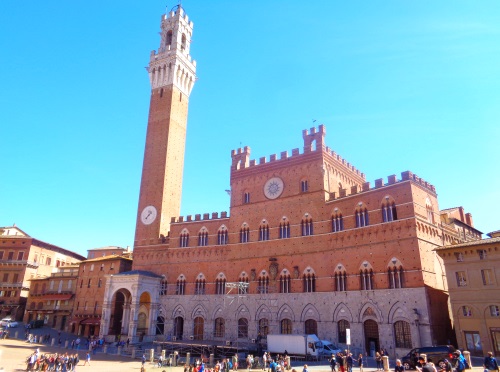
The Palazzo Pubblico is Siena’s historic town hall, standing on the lower edge of Piazza del Campo. Its red-brick façade and tall Torre del Mangia define the city’s best-known square. Today the building still serves civic functions while also housing the Museo Civico, where frescoes and decorated rooms tell stories about Siena’s government, religion and public life.
This guide covers the palace’s history, the Civic Museum, the tower climb and practical visitor information. The museum and tower have different opening times and ticket arrangements. Siena’s official museum site currently notes that tower tickets are not bookable online and are sold at the Palazzo Pubblico ticket office or visitor centre on the day; availability is limited. Check the latest rules before your visit. the official Civic Museum visitor information
Where is Palazzo Pubblico?
The palace faces Piazza del Campo in the centre of Siena’s historic district. Its main façade follows the curve of the square, making it easy to identify. The visitor entrance for the Civic Museum and Torre del Mangia is on the side of the building facing the Campo; the town hall offices use separate areas.
Most visitors arrive on foot. Siena’s centre is built over hills, and the route from the railway station or outer car parks may include steep slopes, escalators or stairs. Check local transport and access options if walking uphill is difficult. Driving into the historic centre is restricted, so use designated parking outside the ZTL and continue on foot or by bus.
History and civic role
Construction of Palazzo Pubblico began at the end of the thirteenth century, during a period when Siena was a powerful independent city. The building was designed as the seat of the government of the Nine, the ruling group that governed the city for much of the fourteenth century. Its location in Piazza del Campo placed civic power at the centre of public life.
The palace remains Siena’s town hall. Its civic role is important when visiting: not every room is part of the museum, and access can be affected by official functions. The visitor route focuses on museum spaces and historic rooms rather than the entire building.
The façade combines brick with stone details and a row of elegant windows. The building’s lower level follows the slope of the Campo, while the tower rises above the square. The overall design is one of the clearest examples of Siena’s Gothic civic architecture.
The Museo Civico
The Civic Museum occupies rooms inside the palace and is best known for its frescoes. These works are not simply decorative; they present ideas about government, justice, civic duty and the relationship between the city and its citizens. Visitors can see how Siena’s ruling authorities used art to express political principles.
Ambrogio Lorenzetti’s Allegory of Good and Bad Government
The most famous cycle is Ambrogio Lorenzetti’s Allegory and Effects of Good and Bad Government, painted in the Sala dei Nove, or Hall of the Nine. One wall presents allegorical figures representing good government and civic virtues. Other walls show the effects of good rule in the city and countryside, contrasted with the consequences of tyranny.
The frescoes are significant because they show political ideas through everyday scenes. The city under good government is full of activity, trade and construction; the countryside is cultivated and productive. The contrasting scenes of bad government include disorder and insecurity. These images offer a rare visual account of how a medieval city understood civic responsibility.
Allow time to look closely. The room is not enormous, but the fresco cycle has many figures, labels and details. A guidebook or audio guide can help explain the allegories, though visitors can also appreciate the vivid depiction of people, streets and landscapes.
Other historic rooms
The museum includes additional rooms with frescoes, portraits, religious works and civic objects. The Sala del Mappamondo contains large wall paintings, including a famous equestrian image of Guidoriccio da Fogliano, though its attribution and interpretation have been discussed by art historians. The rooms reflect different moments in Siena’s political history and artistic development.
Look at the painted walls and ceilings as part of the architecture. The palace was not built as a neutral gallery; these rooms were used by officials and representatives. Their imagery communicated authority and values to the people who governed the city.
Torre del Mangia
The Torre del Mangia rises beside Palazzo Pubblico and offers a wide view over Siena’s rooftops and surrounding hills. It was completed in the fourteenth century and is roughly 88 metres tall, often described as approximately 102 metres including its lightning rod or related measurements. The tower is nearly as high as the cathedral’s bell tower, a design choice traditionally interpreted as a statement about the balance between civic and religious authority.
The climb involves hundreds of steps on a narrow staircase, with limited room to pass other visitors. It may not be suitable for people with heart, breathing, balance or mobility concerns. There is no lift. Follow staff directions, avoid rushing and do not climb if you feel unwell.
Access is controlled by daily capacity. The official museum information says tickets including the tower are sold on the day at the Palazzo Pubblico ticket office or the Dear Guests visitor centre, and cannot be booked online. Tower tickets can sell out. Confirm the latest arrangements and seasonal hours before arriving. the official Civic Museum visitor information

What the view looks like
From the top, visitors can look down on the fan-shaped Piazza del Campo and across the terracotta roofs of Siena. The view extends toward the cathedral and out to the Tuscan landscape. The perspective helps explain the city’s hilltop setting and the compact pattern of its medieval streets.
Photography conditions depend on weather and light. On clear days, the countryside is visible in the distance; haze can soften the view in summer. The top platform can be exposed to wind and sun, so bring a light layer and follow any safety restrictions in place.
Opening hours and tickets
The Civic Museum and tower do not always share the same schedule. Current official information lists seasonal opening times, with shorter winter hours for the tower. The last entry is earlier than the closing time. Hours can change for maintenance, weather, civic events or safety reasons. Check the official page for the current day’s information rather than relying on old guidebooks. the official visitor page
Ticket options may include the Civic Museum alone or combined admission with other museums. Tower tickets have separate purchase rules and may only be available in person. Read the ticket description carefully to see whether it includes the palace museum, tower or another site. If you are visiting in summer or on a weekend, check availability early.
The square outside is free to visit, even if tickets for the palace and tower are sold out. You can still enjoy the façade, the sculptures around Piazza del Campo and the views from nearby streets.
Compare Siena activities
Find tours and current offers for Siena. Check whether the Palazzo Pubblico or tower admission is explicitly included.
Reading the political frescoes
The museum is especially rewarding if you consider how the rooms were used. Officials met here to govern a city whose prosperity depended on trade, agriculture and a network of surrounding communities. The frescoes therefore connect moral ideas with practical concerns such as safety, roads, farming and public order.
In the Hall of the Nine, look at the wall showing the effects of good government in the countryside. Farmers cultivate fields, merchants travel and people move safely through the landscape. The painting is not a documentary photograph; it is an idealised political argument. Its details nevertheless provide a fascinating view of how Siena wanted to present itself.
Compare the scale of the allegorical figure of good government with the smaller scenes of everyday activity. The hierarchy of size directs attention to the principles that the artists and patrons wanted viewers to notice. A museum guide can help explain symbols that are not immediately obvious.
How much time to allow
A visit to the Civic Museum usually takes one to two hours, depending on how carefully you study the frescoes. Add time for the tower climb, ticket purchase and queues. If you want to see both the museum and tower, allow at least half a day for the palace and nearby sights.
The Torre del Mangia can have waiting times because visitors are admitted in limited numbers. Do not plan a tight train connection immediately afterward. If you have limited time, choose between the tower and a slower museum visit rather than rushing both.
Accessibility and visitor comfort
The historic palace has stairs and uneven surfaces. The tower climb is not accessible to wheelchair users and may be difficult for anyone with limited mobility. Contact the museum before visiting to ask about step-free routes, seating and facilities. The availability of accessible areas can differ from the general museum route.
Large bags may be restricted, and security procedures may apply. Wear comfortable shoes and keep water for the walk through Siena, but check whether food and drink are allowed inside the museum. Respect barriers and do not touch frescoed walls or furnishings.
Combining Palazzo Pubblico with nearby sights
Palazzo Pubblico sits directly on Piazza del Campo, so the square is an obvious first or last stop. The Cathedral is a short walk away, as are the Basilica of San Domenico and Santa Maria della Scala. The route is compact but hilly; plan the order to avoid unnecessary climbs.
For more planning, read our pages about Piazza del Campo, Siena’s main sights and the Cathedral of Siena. Check each attraction’s official schedule because opening days and ticket requirements vary.
Where to stay in Siena
Accommodation near the historic centre makes it easy to visit the Campo early and return in the evening. Properties outside the centre can be more convenient for parking or train access, but check the route and elevation. Compare the total cost, cancellation conditions, luggage access and noise level.
Compare Siena accommodation
Search for places near the historic centre or transport links and compare the full price for your dates.
Visiting during events and civic activity
Because Palazzo Pubblico remains Siena’s town hall, official work and public events can affect access to parts of the building. The museum may also have temporary closures or altered routes. Check notices on the museum site before travelling, especially if a specific room or the tower is central to your plans.
On Palio days, the area around the palace becomes extremely busy and access to Piazza del Campo is controlled. The museum and tower may have special arrangements. Visitors not attending the event may prefer to explore at another time, when the square and museum route are easier to enjoy.
Before entering, check whether the museum has temporary room closures or special visitor routes. A small change can affect the order in which you see the frescoes, but the main collection remains rewarding even when one area is unavailable.
Before entering, check whether the museum has temporary room closures or special visitor routes. A small change can affect the order in which you see the frescoes, but the main collection remains rewarding even when one area is unavailable.
Frequently asked questions
Can I visit Palazzo Pubblico without climbing the tower?
Yes. The Civic Museum and tower are distinct visitor experiences. Check current ticket options for the museum alone.
How many steps are in Torre del Mangia?
The climb has several hundred steps on a narrow staircase. Follow current safety guidance and assess whether it suits your fitness and mobility.
Can I book tower tickets online?
Current official guidance says tower tickets are sold in person on the day and are not bookable online. This can change, so verify before visiting.
Is the palace still Siena’s town hall?
Yes. The building continues to serve civic functions as well as housing the Museo Civico.
What is the most famous artwork in the museum?
Ambrogio Lorenzetti’s fresco cycle on good and bad government is one of its best-known works.
Summary
Palazzo Pubblico combines Siena’s active civic life with a major medieval art collection. The Museo Civico’s frescoes, especially Lorenzetti’s scenes of government, give context to the city’s history, while Torre del Mangia offers a memorable view for visitors able to manage the climb. Check current hours and same-day tower ticket rules, and leave enough time to explore Piazza del Campo.