Lucca is a compact Tuscan city best known for its Renaissance walls, Roman amphitheatre-shaped Piazza dell’Anfiteatro, churches and medieval towers. The historic centre is easy to explore on foot or by bicycle, and its scale makes it a good day trip from Pisa or Florence. Unlike many Tuscan hill towns, Lucca is relatively level inside the walls, though some church towers require steep climbs.
This guide introduces the main sights and suggests a practical route through the city. Opening hours and admission rules vary by monument and season. Lucca’s official tourism site confirms that the walls are freely accessible and that most of the historic centre is a restricted traffic zone, making walking and cycling the easiest ways to get around. Lucca Tourism’s wall guide
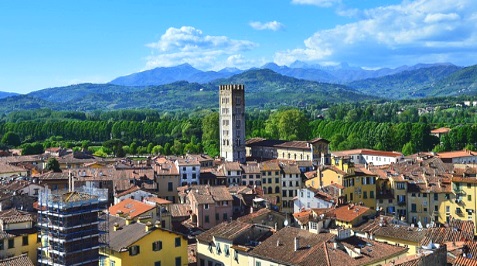
Why visit Lucca?
Lucca combines a walkable historic centre with an unusually complete Renaissance wall circuit. Inside the walls are Roman remains, medieval churches, narrow shopping streets and quiet squares. The city’s atmosphere is less hurried than Florence’s, and many visitors enjoy exploring without a strict timetable.
The main sights lie close enough to combine in one day. A simple route can include the city walls, Piazza dell’Anfiteatro, San Michele in Foro and the Cathedral of San Martino. Visitors who want to climb towers or enter museums should check opening hours and allow extra time.
Lucca is also associated with composer Giacomo Puccini, who was born in the city. A museum in his birthplace and local music events add another dimension for visitors interested in opera. Check current programmes before planning around a concert.
The Renaissance city walls
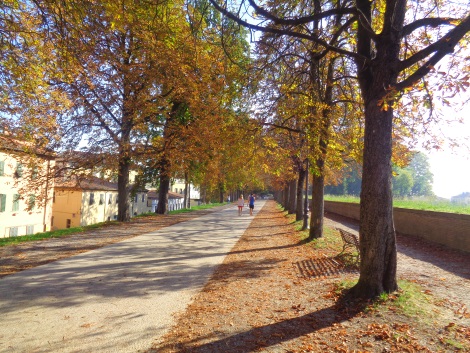
The four-kilometre walls are Lucca’s most distinctive feature. The present Renaissance circuit was built between 1544 and 1650 and later adapted as a public promenade. Its broad tree-lined top makes a pleasant walking and cycling route with views over rooftops, church towers and the countryside.
The complete circuit takes around an hour at a relaxed pace, but you can walk only one section and descend at any of the gates. The walls are free to access. Share the path with cyclists, runners and local residents, and keep children away from the edges. Our separate guide to the Walls of Lucca covers access points and the full loop.
Piazza dell’Anfiteatro
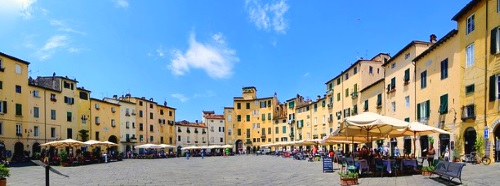
Piazza dell’Anfiteatro is a distinctive oval square built within the footprint of a Roman amphitheatre. The curved façades of the surrounding buildings preserve the outline of the ancient arena. The current square took shape over many centuries, with homes and shops built into the former structure.
Several entrances lead into the piazza through arches. Inside, cafés, restaurants and small shops face the central open area. It is an easy place to stop for coffee, but prices may be higher than on streets farther from the square. Look up at the curved façades and notice how the irregular windows follow the ancient oval plan.
The Roman amphitheatre itself is no longer standing as a complete ruin. Its shape survives in the urban layout, making the square a good example of how ancient structures can continue to shape a modern city.
Cathedral of San Martino
Lucca Cathedral, or Cattedrale di San Martino, is a major religious and artistic landmark. Its façade has an unusual asymmetry because it was built beside an existing bell tower. The exterior combines Romanesque details with later Gothic elements, while the interior contains works by artists including Jacopo della Quercia, Tintoretto and Ghirlandaio.
Two of the cathedral’s most important treasures are the funerary monument of Ilaria del Carretto and the revered wooden crucifix known as the Volto Santo. The monument of Ilaria, sculpted by Jacopo della Quercia, is admired for the quiet realism of the recumbent figure. The Volto Santo has a long religious history and is central to Lucca’s local traditions.
The Cathedral Museum, bell tower and archaeological complex are separate parts of the wider visit. Ticket options may combine several sites. Opening hours can change for liturgical services, so consult the official cathedral museum website before going. Read our detailed guide to the Cathedral of San Martino.
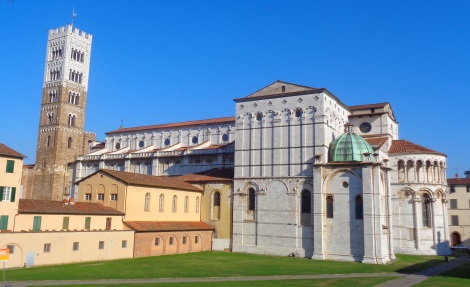
Piazza San Michele and the Church of San Michele in Foro
Piazza San Michele occupies the site of the Roman forum and has been a centre of public life for centuries. The Church of San Michele in Foro dominates the square with a tall marble façade topped by a statue of the archangel Michael. Its columns, arches and decorative inlays make the façade especially striking.
The church is associated with different phases of construction and combines Romanesque and Gothic details. The interior contains artworks and chapels, but access can be affected by services. Lucca’s tourism information lists the church as open daily, while the bell tower has separate paid access and no lift. Check the current schedule before visiting. Lucca Tourism’s San Michele guide
Guinigi Tower
The Guinigi Tower is one of Lucca’s most recognisable landmarks because a small garden of holm oaks grows at the top. The tower stands about 45 metres high and provides a view over the city’s roofs and walls. The climb uses a staircase; there is no lift, and the upper garden is not accessible to visitors with mobility disabilities. Reservations are recommended on weekdays and required on weekends and holidays according to current tourism information. Lucca Tourism’s Guinigi Tower visitor information
Check ticket availability and opening hours before planning the climb. If you prefer not to use stairs, you can still see the tower from streets and squares below. The nearby Torre delle Ore is another historic tower, but it has different access and ticket arrangements.
Other churches, museums and places to see
Lucca has many smaller attractions, including the Basilica of San Frediano, with its gold mosaic façade, and the Church of San Giovanni and Santa Reparata, which includes an archaeological area. The Museo Nazionale di Villa Guinigi presents art and sculpture connected with Lucca and its region. Opening hours and ticket rules differ, so choose according to your interests.
Casa Puccini, the composer’s birthplace, introduces visitors to his life and work. Music lovers may also want to check whether an opera or concert is scheduled during their stay. The city hosts cultural events throughout the year, and programmes can change seasonally.
Via Fillungo is Lucca’s main shopping street and follows part of the route of the ancient Roman Cardo. It has boutiques, cafés and everyday shops. For a quieter walk, explore side streets toward the walls and residential neighbourhoods.
A suggested walking route
Start at Lucca’s railway station and enter the historic centre through a nearby gate. Walk a section of the walls for an overview, then descend toward the Cathedral of San Martino. Continue to Piazza San Michele and Piazza dell’Anfiteatro, with a break for lunch or coffee. If you have time, climb the Guinigi Tower or visit one of the museums.
The route can be shortened or rearranged. If you want to visit the cathedral complex, check its hours first because it may close earlier or pause access for services. Tower climbs take time and may require reservations. Keep some unplanned time for the streets and squares between major sights.
Lucca’s towers and rooftops
In addition to the Guinigi Tower, the historic centre has several medieval towers and bell towers that shape the skyline. The Torre delle Ore, with its clock, is another place where visitors may be able to climb, subject to current hours and conditions. From the streets below, the towers help orient you as you move between the main squares.
Many buildings are privately owned or used for homes and businesses, so not every tower is open to visitors. Check official information before planning a climb. Historic staircases can be steep and narrow, and the view from a tower is not worth risking a climb that feels unsafe or uncomfortable.
Lucca’s churches and music heritage
The city has more churches than most visitors can see in one day. San Frediano, San Michele in Foro and the Cathedral are among the best-known, but smaller churches can be rewarding if you have time. Opening hours may be interrupted by services. Dress respectfully and check whether photography is allowed.
Puccini’s connection with Lucca is visible in museums and musical events. If you are interested in opera, look for concerts in historic churches or theatres during your travel dates. Programmes are seasonal, and some require advance reservations.
Visiting Lucca with limited mobility
Lucca’s centre is comparatively level, but cobbles, narrow pavements and historic thresholds can still be challenging. The walls have ramps and stairs at different gates, and some monuments have no lift. Check individual accessibility details rather than assuming that a generally flat city means every site is accessible.
If you need step-free routes, ask the local visitor information point for current recommendations. Consider using the broad wall promenade only from an entrance with a suitable ramp. At churches and towers, contact the operator in advance about thresholds, seating, accessible toilets and assistance.
Many central attractions are open at different hours, so plan indoor visits around outdoor walks. The city walls are flexible and free, while towers and museums usually require a ticket or reservation. Checking opening days first helps you make the most of a short stay.
How to get to Lucca
Lucca is connected by regional train with Pisa and Florence. The station is just outside the southern side of the walls, so the historic centre is easy to reach on foot. Buses connect the city with nearby towns, and long-distance services may use different stops. Check departure points carefully when returning.
If you arrive by car, use a car park outside the restricted traffic zone. The historic centre is not designed for visitor driving, and access rules are enforced. Confirm whether your hotel has permission to register a vehicle before entering the ZTL.
Food and local specialities
Lucca’s restaurants serve Tuscan dishes such as tordelli lucchesi, soups, cured meats and local wines. Bakeries and cafés are useful for a quick snack between sights. Restaurants near Piazza dell’Anfiteatro and the main streets are convenient, while a few blocks away you may find a broader choice of prices.
Check menus outside before sitting down, and note whether a cover charge or service fee is listed. If you have dietary restrictions, ask about ingredients. In warm weather, take breaks and carry water while walking the walls.
Where to stay in Lucca
Staying inside the walls makes it easy to explore on foot and enjoy the city after day-trippers leave. Accommodation outside the historic centre may be more convenient for parking. Compare the exact address, stairs, noise, transport links and cancellation conditions.
Compare accommodation in Lucca
Search by location and total price, and check parking or ZTL access if you are travelling by car.
Compare Lucca experiences
Check current guided tours and activities, including the route, duration and meeting point.
Frequently asked questions
How long should I spend in Lucca?
A day is enough for the main sights, but an overnight stay allows a more relaxed visit and time for museums or towers.
Can I walk the city walls?
Yes. The 4.2-kilometre circuit is a public promenade and is free to access.
Is Lucca flat?
The historic centre is relatively level compared with many Tuscan hill towns, but the walls and some tower climbs involve ramps or stairs.
Can I visit Lucca by car?
You can reach the city by car, but park outside the ZTL and explore the centre on foot or by bicycle.
What is Lucca best known for?
The Renaissance walls, Piazza dell’Anfiteatro, the Cathedral of San Martino and historic towers are among its best-known sights.
Map of Lucca
The map below shows the historic centre and can help you plan a route between the walls and main sights. Check current city information for access or construction changes.
Summary
Lucca is a rewarding city for a relaxed walk, with a complete ring of Renaissance walls and a compact historic centre. Visit the main squares, churches and towers, but check access and ticket details for interiors. Walking or cycling is the easiest way to explore, while the walls provide an ideal route to see the city from above.