 Posted by
 Jellyfish are found all around the coast of Italy, from the Adriatic Sea and the beaches of Rimini to Tuscany, the Amalfi Coast, Sicily and Sardinia. Most jellyfish that tourists see are either harmless or cause only mild irritation, but several Mediterranean species can produce painful stings.
Our Tip: Book accommodations in Italy easily via Booking.com: real reviews, large selection, fair prices, and flexible cancellation.
The species of greatest practical importance to swimmers is the mauve stinger (Pelagia noctiluca). It is widespread in the Mediterranean and can occasionally occur in large numbers close to beaches. Its sting can cause intense burning pain, redness and skin lesions, although serious systemic reactions are uncommon.
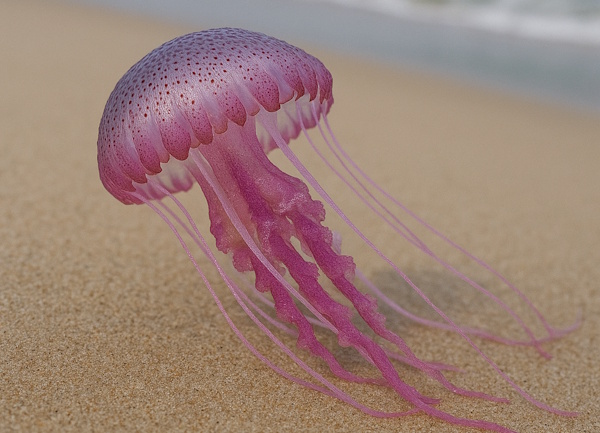
Jellyfish numbers can change dramatically within a short period. A beach may have many jellyfish one day and virtually none shortly afterwards because wind, currents and local ocean conditions move the animals. This is why a report of jellyfish in Sardinia, Sicily or Rimini does not mean the entire region is affected.
This guide explains where jellyfish occur in Italy, which species tourists may see, which jellyfish sting, when jellyfish season occurs and what to do after a jellyfish sting.
Jellyfish in Italy at a Glance
| Question | Answer |
|---|---|
| Are there jellyfish in Italy? | Yes, along all Italian seas |
| Are most jellyfish dangerous? | No |
| Most important stinging species | Mauve stinger – Pelagia noctiluca |
| Are there jellyfish in the Adriatic? | Yes |
| Are there jellyfish in Sardinia? | Yes |
| Are there jellyfish in Sicily? | Yes |
| Are there jellyfish on the Amalfi Coast? | Yes, occasionally |
| Main tourist season for encounters | Late spring to autumn, although jellyfish can occur outside this period |
| Should you touch a dead jellyfish? | No |
| Should you rinse a sting with freshwater? | Generally no; seawater is the safer initial rinse |
| Should you always use vinegar? | No – treatment is species-dependent |
| Emergency number in Italy | 112 |
Are There Many Jellyfish in Italy?
Jellyfish are a normal part of the Mediterranean ecosystem, and they occur in all seas surrounding Italy. This does not mean that Italian beaches are permanently full of jellyfish.
The number close to shore can vary enormously according to location, season, currents, wind, water temperature, food availability and reproduction. Large concentrations are often referred to as jellyfish blooms.
Some summers and locations experience much more noticeable jellyfish activity than others. Even within the same region, two beaches only a few kilometers apart can have very different conditions.
For tourists, this means that broad statements such as “Sardinia has a jellyfish problem this summer” should be treated cautiously. Jellyfish conditions are usually much more local and temporary.
Top Experiences in Italy
While you’re in Italy, don’t miss the most popular tours and attractions. Many sell out in advance, especially in high season.
Why Do Jellyfish Suddenly Appear at a Beach?
Jellyfish are strongly influenced by the movement of seawater. Wind and currents can concentrate large numbers close to one section of coast while leaving another area almost clear.
Research in the Ligurian Sea has shown that current position and wind can strongly influence the arrival of jellyfish at the coast.
This explains a situation familiar to many Mediterranean beachgoers: dozens of jellyfish may appear seemingly overnight and disappear again after conditions change.
The jellyfish have not necessarily reproduced suddenly beside the beach. They may simply have been transported there from offshore waters.
Where Are Jellyfish Found in Italy?
Jellyfish can occur along virtually the entire Italian coastline. The species and frequency of sightings vary between the Adriatic, Ionian, Tyrrhenian and Ligurian seas and around the major islands.
Jellyfish in the Adriatic Sea
Yes, there are jellyfish in the Adriatic Sea. They can appear along the Italian Adriatic coast from Friuli-Venezia Giulia and Veneto through Emilia-Romagna, Marche, Abruzzo, Molise and Puglia.
The northern Adriatic is relatively shallow compared with many other parts of the Mediterranean. Several jellyfish species can occur there, and blooms occasionally become highly visible because the coast has enormous numbers of summer visitors.
Jellyfish in Rimini and Riccione
Jellyfish can occur off Rimini, Riccione and the other resorts of Emilia-Romagna. However, their presence varies greatly from day to day.
Finding several jellyfish at the beach does not automatically mean swimming is dangerous. The relevant questions are which species is present and how many animals are in the bathing area.
If lifeguards advise people to stay out of the water because large numbers of stinging jellyfish have arrived, tourists should follow that local advice.
Jellyfish in Jesolo, Bibione and Caorle
Jellyfish can also occur at the sandy holiday beaches of Jesolo, Bibione and Caorle in Veneto.
As elsewhere on the Adriatic, conditions can change quickly with currents and wind. There is no reliable rule that one of these resorts consistently has more jellyfish than another.
Jellyfish near Trieste
The Gulf of Trieste supports several jellyfish species. At certain times, large jellyfish can be particularly visible in the gulf and around ports and sheltered coastal areas.
Not every large jellyfish is dangerous. Some of the biggest Mediterranean species have relatively mild stings.
Jellyfish in Tuscany
Jellyfish occur along the Tuscan coast and around the islands of the Tuscan Archipelago.
Mauve stingers and other Mediterranean jellyfish can be transported toward shore by currents. Their distribution is never uniform along the entire coast.
Popular areas including Viareggio, the Maremma coast and the waters around Elba can all experience jellyfish sightings.
Jellyfish around Elba
Jellyfish are part of the natural marine ecosystem surrounding Elba. Snorkelers may see both harmless or mildly stinging species and, occasionally, more strongly stinging species such as Pelagia noctiluca.
The presence of jellyfish is normally temporary and is not a reason to avoid an Elba holiday.
Jellyfish on the Amalfi Coast
Jellyfish can occur on the Amalfi Coast and in the wider Tyrrhenian Sea.
They may occasionally be seen around Positano, Amalfi, Praiano, Maiori and neighboring coastal areas. As elsewhere in Italy, their presence depends heavily on currents and local conditions.
One advantage of the steep Amalfi coastline is that tourists often have several beaches and bathing areas within relatively short distances. Conditions may differ from one bay to another.
Jellyfish around Naples, Capri and Ischia
The Gulf of Naples and waters around Capri and Ischia also contain jellyfish.
The region has deep offshore waters and complex currents, and jellyfish may occasionally be carried close to bathing areas.
Most tourists will not experience a serious jellyfish problem. If large numbers arrive at a particular beach, local conditions may improve again when currents change.
Jellyfish in Sicily
Sicily is surrounded by jellyfish habitat. Jellyfish can occur around Palermo, Cefalù, Taormina, Catania, Syracuse, Trapani and the smaller islands.
The waters around Sicily are particularly interesting biologically because the island sits between different parts of the Mediterranean.
The Strait of Messina has also been extensively studied in connection with Pelagia noctiluca. Research has documented recurring reproductive and bloom patterns of this species there.
This does not mean that Sicilian beaches are constantly affected. Jellyfish distribution remains highly variable.
Jellyfish in Taormina
Jellyfish can occasionally occur around Taormina and Isola Bella. Clear water does not prevent jellyfish from being present; in fact, clear conditions can simply make them easier to see.
If one or two jellyfish are visible, look carefully before entering the water and ask local lifeguards if you are unsure whether a strongly stinging species is present.
Jellyfish in Sardinia
Yes, Sardinia has jellyfish. They can appear along both the northern and southern coasts as well as on the eastern and western sides of the island.
This includes famous holiday areas such as the Costa Smeralda, Gulf of Orosei, Alghero and the beaches around Cagliari.
It is misleading, however, to speak of “the jellyfish situation in Sardinia” as though the entire island had identical conditions. Sardinia has an extremely long coastline, and local currents can produce completely different conditions on opposite sides of the island.
A beach affected today may be clear tomorrow, while another beach can experience an arrival of jellyfish.
Jellyfish in Puglia
Puglia has coastline on both the Adriatic and Ionian seas and therefore naturally has jellyfish.
They can occur around the Gargano, Bari, Brindisi and the beaches of Salento.
ISPRA-associated monitoring in southern Italy identified Pelagia noctiluca, the Mediterranean box jellyfish Carybdea marsupialis and Olindias phosphorica among the more important stinging species recorded in Salento waters.
Jellyfish in Calabria
Calabria has long coastlines on both the Tyrrhenian and Ionian seas. Jellyfish can therefore occur around popular destinations including Tropea and the Costa degli Dei as well as the Ionian coast.
The Strait of Messina between Calabria and Sicily is especially dynamic, but ordinary beachgoers should still regard jellyfish as an occasional rather than constant hazard.
Jellyfish on the Ligurian Coast and Cinque Terre
Jellyfish occur in the Ligurian Sea and can be transported toward beaches around Genoa, Portofino, the Italian Riviera and Cinque Terre.
Wind and current patterns play an important role in whether offshore jellyfish reach the coast. Consequently, a jellyfish report from one Ligurian bay tells you relatively little about conditions tens of kilometers away.
Jellyfish near Rome and Lazio
Jellyfish occur in the Tyrrhenian Sea off Lazio, including the coastal areas accessible from Rome.
Visitors swimming around Ostia, Santa Marinella and other Lazio beaches can occasionally encounter them.
There is no general reason for tourists to worry about jellyfish before visiting Rome. It only becomes relevant when planning time at the coast.
Common Jellyfish Species in Italy
Italy has numerous jellyfish and jellyfish-like species. For tourists, only a small number are particularly useful to recognize.
Mauve Stinger – Pelagia noctiluca
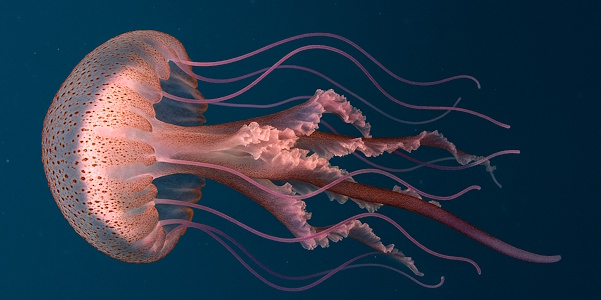
The mauve stinger (Pelagia noctiluca) is probably the most important jellyfish for Italian beachgoers.
It is usually pinkish, violet, reddish or brownish and is relatively small compared with some of the huge barrel jellyfish seen around Italy. Tentacles can extend far beyond the bell.
The species is also bioluminescent, which explains the Latin name noctiluca, referring to light at night.
Its sting can be very painful. Typical effects include burning pain, redness, swelling and raised or blister-like skin lesions. Systemic reactions occur much less often.
For tourists, this is much more relevant than its formal taxonomy: if a small purple or pink jellyfish is present in substantial numbers, do not assume it is harmless.
Barrel Jellyfish – Rhizostoma pulmo
The barrel jellyfish (Rhizostoma pulmo) is one of the largest jellyfish commonly seen in the Mediterranean.
Its large size often alarms swimmers, but appearance is not a reliable guide to danger. Rhizostoma pulmo has relatively low stinging potential compared with Pelagia noctiluca.
It usually has a large pale or bluish-white bell with a darker blue or purple margin.
Even species regarded as mild should not be deliberately handled. Individual skin reactions can vary.
Fried Egg Jellyfish – Cotylorhiza tuberculata
The unusually shaped fried egg jellyfish (Cotylorhiza tuberculata) is another characteristic Mediterranean species.
Its yellowish central dome gives it the appearance of a fried egg when viewed from above.
It generally has low stinging potential for humans and is considerably less concerning to swimmers than the mauve stinger.
It can sometimes be surrounded by small fish using the jellyfish for shelter.
Moon Jellyfish – Aurelia Species
Moon jellyfish are recognizable by their almost transparent bell and four characteristic horseshoe-shaped reproductive structures visible through the body.
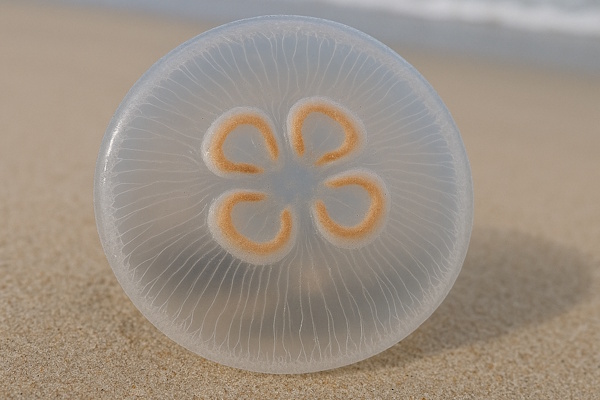
Their sting is usually mild for humans, although sensitive individuals may still develop irritation.
The exact taxonomy of Mediterranean Aurelia populations is more complicated than simply calling every animal Aurelia aurita, so a tourist guide does not need to promise a precise species identification based on appearance alone.
Compass Jellyfish – Chrysaora hysoscella
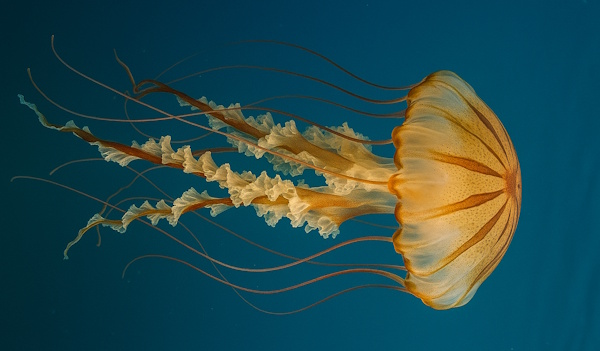
The compass jellyfish has characteristic brown V-shaped or radial markings across the bell.
Its tentacles can sting and cause painful local skin reactions.
If you see a jellyfish with distinctive dark compass-like markings, it is sensible to avoid contact.
Mediterranean Box Jellyfish – Carybdea marsupialis
Italy also has a Mediterranean box jellyfish, Carybdea marsupialis.
It is much smaller and less infamous than the large tropical box jellyfish associated with northern Australia, but its sting can still be painful.
It has been identified among the more important stinging jellyfish in southern Italian waters.
This species is also important because first aid can differ between jellyfish species. Laboratory work found that vinegar inhibited nematocyst discharge in Carybdea marsupialis but produced the opposite effect in Pelagia noctiluca.
Olindias phosphorica
Olindias phosphorica is another Mediterranean jellyfish capable of causing a painful sting.
It is less familiar to tourists than the mauve stinger but has been identified as medically relevant in parts of southern Italy.
Portuguese Man O’ War – Physalia physalis
The Portuguese man o’ war is occasionally discussed together with jellyfish, although biologically it is not a true jellyfish but a colonial hydrozoan.
It is primarily associated with Atlantic waters but can occasionally enter the Mediterranean.
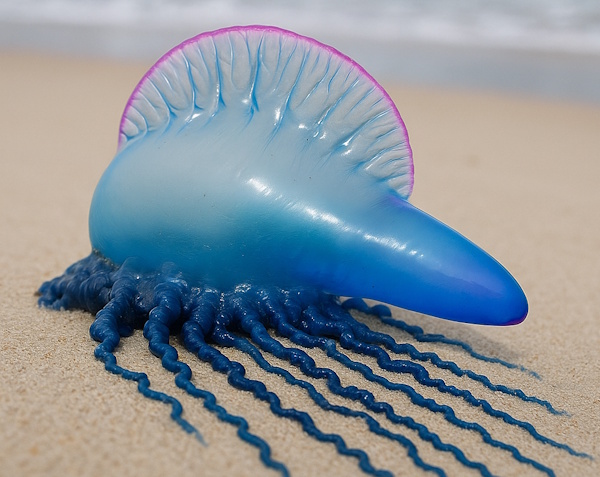
Its tentacles are capable of causing severe and potentially dangerous stings. Any sighting should therefore be treated seriously.
Fortunately, this is not an animal the ordinary tourist should expect to see on a normal Italian beach holiday.
Which Is the Most Dangerous Jellyfish in Italy?
For ordinary Italian beachgoers, Pelagia noctiluca is the most important strongly stinging species because it is widespread, can occur in large numbers and frequently causes human stings.
Scientific literature describes it as one of the most important Mediterranean jellyfish because of both its abundance and severity of stings.
Calling it “the deadliest jellyfish in Italy” would be misleading. Most stings cause painful local reactions rather than life-threatening poisoning.
The more useful description for tourists is: common enough to matter, painful enough to avoid, but normally not a major danger to a healthy adult.
When Is Jellyfish Season in Italy?
There is no exact nationwide jellyfish season.
Different species have different life cycles, and jellyfish can occur in Italian waters outside the main summer holiday period.
However, tourists notice them most often from late spring through summer and into autumn, partly because this is when millions of people are swimming and partly because conditions favor visible blooms of several Mediterranean species.
| Period | Typical Situation for Tourists |
|---|---|
| March–April | Jellyfish possible, but fewer tourists are swimming |
| May | Sightings become more relevant as beach season begins |
| June | Jellyfish encounters possible throughout Italian coastal regions |
| July | Main swimming season; local blooms can occur |
| August | Main swimming season; local blooms can occur |
| September | Jellyfish remain possible and sea temperatures are still warm |
| October | Still possible, especially in warmer southern waters |
| Winter | Jellyfish remain part of the ecosystem, but encounters matter less to tourists |
Are There More Jellyfish in Italy in July and August?
July and August are the months when jellyfish attract the most attention because Italian beaches are at their busiest.
This does not necessarily mean that every jellyfish species reaches its maximum abundance exactly in those two months.
A useful distinction is between jellyfish abundance and human encounters. Even moderate jellyfish numbers can produce many sting reports when huge numbers of tourists are swimming.
Are There Jellyfish in Italy in September?
Yes. September is still well within the period when tourists can encounter jellyfish in Italy.
The Mediterranean remains warm, particularly around Sicily, Sardinia and southern Italy.
Do not assume that the end of August means jellyfish have disappeared.
Our Tip: Book accommodations in Italy easily via Booking.com: real reviews, large selection, fair prices, and flexible cancellation.
Can You Predict Jellyfish at an Italian Beach?
Only to a limited extent.
Jellyfish movements depend strongly on oceanographic conditions. Wind and currents can transport animals toward or away from the coast.
The most useful information for a tourist is therefore often local and recent rather than a national forecast.
Check:
- lifeguard information;
- signs at the beach;
- local municipality information;
- reports from nearby swimmers;
- current beach conditions.
A social-media photo from a beach several days earlier is much less useful because conditions may have changed completely.
Can You Swim If There Are Jellyfish?
That depends on the number and species.
If one harmless or mildly stinging jellyfish is visible far from swimmers, a beach does not automatically become unusable.
If numerous mauve stingers or unidentified strongly stinging jellyfish are present, staying out of the water is sensible.
Never ignore instructions from lifeguards or local authorities.
Do Jellyfish Swim Toward People?
No. Mediterranean jellyfish do not hunt swimmers.
They can move through the water to some extent, but currents largely determine where large numbers of jellyfish accumulate.
A jellyfish moving toward you is not deliberately attacking. Contact happens because swimmer and jellyfish happen to occupy the same water.
Top Experiences in Italy
While you’re in Italy, don’t miss the most popular tours and attractions. Many sell out in advance, especially in high season.
Can Dead Jellyfish Still Sting?
Yes. Do not touch jellyfish lying on the beach.
Nematocysts in tentacle tissue may remain capable of firing after the animal is stranded or dead.
Children in particular should be told not to pick up jellyfish or pieces of tentacle washed onto the sand.
What Does a Jellyfish Sting Feel Like?
Symptoms vary according to species and individual sensitivity.
A sting from Pelagia noctiluca often causes:
- immediate burning or stinging pain;
- redness;
- linear or irregular raised marks where tentacles touched the skin;
- swelling;
- itching;
- small vesicles or blister-like lesions.
The pain usually remains localized, although extensive contact can produce a more significant reaction.
First Aid for a Jellyfish Sting in Italy
The old idea that every jellyfish sting should be treated in exactly the same way is increasingly recognized as problematic. Different species can react differently to substances such as vinegar.
For an unidentified Mediterranean jellyfish sting, a cautious practical approach is:
1. Leave the water safely
Get out of the sea, particularly if pain is severe. Sudden pain can make swimming difficult and create an additional drowning risk.
2. Do not rub the skin
Rubbing with your hands, a towel or sand can mechanically stimulate remaining stinging cells.
3. Rinse with seawater
Use seawater rather than freshwater to gently rinse the affected area and remove loose material.
WHO guidance for marine invertebrate stings includes washing the affected area with seawater.
4. Remove remaining tentacles carefully
If tentacle material remains attached, avoid touching it with bare fingers. Remove it carefully using tweezers or another suitable barrier if available.
Do not aggressively scrape the skin.
5. Use heat for pain relief when practical
WHO guidance indicates that immersion in hot water at around 45 °C for approximately 20 minutes can reduce pain following marine invertebrate stings. The water should never be hot enough to cause a burn.
If hot-water immersion is impractical because the sting covers a large area, seek advice from a lifeguard or medical professional.
Should You Use Vinegar on a Jellyfish Sting in Italy?
Not automatically.
This is one of the most important corrections to many older jellyfish guides.
Vinegar can be useful for some jellyfish species, but its effect is species-dependent.
Laboratory research on two Mediterranean species found that vinegar triggered nematocyst discharge in the mauve stinger Pelagia noctiluca, making it potentially counterproductive. In contrast, vinegar inhibited discharge from the Mediterranean box jellyfish Carybdea marsupialis.
Because Pelagia noctiluca is one of the most important causes of jellyfish stings on Mediterranean beaches, tourists should not use vinegar as a universal treatment for every unidentified jellyfish sting in Italy.
Should You Rinse a Jellyfish Sting with Fresh Water?
Fresh water is generally not recommended as the initial rinse for an unidentified marine jellyfish sting.
Use seawater instead.
The objective is to remove remaining tentacle material without stimulating additional nematocyst discharge.
Should You Pee on a Jellyfish Sting?
No.
The familiar idea of urinating on a jellyfish sting is not a recommended first-aid method.
Use proper first aid: leave the water, avoid rubbing, rinse appropriately, remove tentacles carefully and manage pain.
Should You Put Sand on a Jellyfish Sting?
No. Rubbing the skin with sand can mechanically irritate the area and potentially stimulate remaining stinging cells.
Do not scrub the affected skin.
When Is a Jellyfish Sting an Emergency?
Most Mediterranean jellyfish stings cause local symptoms and do not become medical emergencies.
Call 112 or obtain urgent medical help if the person develops:
- difficulty breathing;
- loss of consciousness;
- severe dizziness or collapse;
- signs of anaphylaxis;
- chest pain;
- a major reaction involving large areas of the body;
- rapidly worsening systemic symptoms.
WHO recommends monitoring marine-sting victims for breathing problems, severe allergic reactions and anaphylaxis.
Are Jellyfish Stings More Dangerous for Children?
Children should be monitored carefully because the same amount of tentacle contact represents a larger exposure relative to a small body size.
Children may also panic when suddenly experiencing severe pain in the water.
Get the child out of the water immediately, avoid rubbing the sting and ask a lifeguard for assistance where available.
Can Jellyfish Stings Leave Scars?
Most uncomplicated Mediterranean jellyfish stings heal without permanent scarring.
However, discoloration, irritation or skin marks can sometimes persist after the initial pain has disappeared, particularly after a substantial Pelagia noctiluca sting.
Avoid excessive scratching and seek medical advice if skin lesions worsen, become infected or fail to heal normally.
How Long Does a Jellyfish Sting Hurt?
Duration varies considerably according to species, extent of contact and individual reaction.
Severe burning may decrease relatively quickly in some people, while pain, itching and visible skin irritation can persist for hours or longer.
If symptoms continue to worsen rather than improve, medical assessment is advisable.
Can You Avoid Jellyfish Stings?
No method provides complete protection, but several simple measures reduce risk.
- Look at the water before entering.
- Ask lifeguards about current conditions.
- Stay out if large numbers of stinging jellyfish are present.
- Do not touch jellyfish, even if they appear dead.
- Do not allow children to play with stranded jellyfish.
- Consider protective swimwear when jellyfish are being reported.
Do Water Shoes Protect Against Jellyfish?
Water shoes protect the feet but do little for the rest of the body.
They are much more useful against weever fish, sharp rocks and sea urchins than against free-swimming jellyfish whose tentacles may contact legs, arms or torso.
Jellyfish vs. Weever Fish in Italy
Both are relevant natural hazards for Italian beachgoers, but the mechanism is completely different.
Jellyfish: tentacles contact exposed skin while swimming.
Weever fish: swimmers normally step onto venomous spines of a fish buried in sand.
This distinction also matters for first aid. The treatment of a weever fish sting should not simply be copied for every jellyfish sting.
Are Jellyfish a Reason to Avoid an Italian Beach Holiday?
No.
Jellyfish are a normal part of Mediterranean marine life. Italy has thousands of kilometers of coastline and millions of people swim safely every year.
Blooms can temporarily make a particular beach unpleasant, but they are usually localized. Nearby beaches may have completely different conditions.
For most travelers, knowing how to recognize the important species and how to respond to a sting is far more useful than worrying about jellyfish before the holiday.
Frequently Asked Questions About Jellyfish in Italy
Are there jellyfish in Italy?
Yes. Jellyfish occur in all seas around Italy, including the Adriatic, Tyrrhenian, Ionian and Ligurian seas and around Sicily and Sardinia.
Are jellyfish common in Italy?
They are a normal part of the marine ecosystem, but numbers vary enormously. Some beaches experience temporary blooms while others have few or no jellyfish at the same time.
What is the most dangerous jellyfish in Italy?
For ordinary beachgoers, the mauve stinger (Pelagia noctiluca) is one of the most important strongly stinging species because it is widespread and can occur in substantial numbers.
Are there jellyfish in Rimini?
Yes. Jellyfish can occur in the Adriatic Sea around Rimini and Riccione, although conditions vary from day to day.
Are there jellyfish in Sardinia?
Yes. Jellyfish occur all around Sardinia, but their abundance is highly localized and temporary.
Are there jellyfish in Sicily?
Yes. Sicily has several jellyfish species, including the strongly stinging mauve stinger.
Are there jellyfish on the Amalfi Coast?
Yes. Jellyfish can occur in the Tyrrhenian Sea around the Amalfi Coast, but large concentrations are temporary rather than permanent.
Are there jellyfish around Elba?
Yes. Jellyfish occur in the waters around Elba and the Tuscan Archipelago.
Are there jellyfish in Puglia?
Yes. Both the Adriatic and Ionian coasts of Puglia can have jellyfish. Several strongly stinging species have been documented in southern Italian waters.
Are there jellyfish around Capri?
Yes. Jellyfish are part of the marine ecosystem around Capri and the Gulf of Naples, although most tourists do not experience a serious problem.
Are there jellyfish in Italy in June?
Yes. Jellyfish can occur in June, and sightings become more relevant as the main bathing season begins.
Are there jellyfish in Italy in July and August?
Yes. Jellyfish can occur throughout the peak summer season. Local blooms may temporarily bring large numbers close to beaches.
Are there jellyfish in Italy in September?
Yes. September is still a normal period for jellyfish encounters, particularly because Mediterranean waters remain warm.
Can dead jellyfish sting?
Yes. Stinging cells in tentacles may remain active after a jellyfish has washed ashore. Do not touch dead jellyfish.
Should I use vinegar on a jellyfish sting in Italy?
Not automatically. Vinegar may worsen nematocyst discharge from the common Mediterranean mauve stinger, while it can be useful for certain other species. It should therefore not be treated as a universal Mediterranean first-aid treatment.
Should I rinse a jellyfish sting with seawater?
Yes. Seawater is a sensible initial rinse for an unidentified marine jellyfish sting. Avoid rubbing the affected skin.
Should I rinse a jellyfish sting with fresh water?
Fresh water is generally not recommended as the first rinse for an unidentified marine jellyfish sting. Use seawater instead.
Should I pee on a jellyfish sting?
No. Urine is not recommended first aid for jellyfish stings.
When should I call an ambulance?
Call 112 if there are breathing difficulties, loss of consciousness, a severe allergic reaction, collapse or other serious systemic symptoms.
Can I still swim if jellyfish have been reported?
Possibly, depending on the species and number present. Ask lifeguards and check current conditions. If many strongly stinging jellyfish are in the bathing area, staying out of the water is sensible.
Conclusion: Jellyfish in Italy Are Common but Usually Manageable
Jellyfish are found throughout Italian coastal waters, including the Adriatic, Tuscany, Liguria, Lazio, the Amalfi Coast, Calabria, Puglia, Sicily and Sardinia.
Their presence is highly variable. Wind and currents can bring large numbers to one beach while another beach nearby remains almost completely clear. For this reason, current local information is much more useful than general claims that an entire Italian region has “lots of jellyfish.”
The species tourists should particularly recognize is the mauve stinger (Pelagia noctiluca). It is widespread in the Mediterranean and produces painful stings. Large barrel jellyfish and fried egg jellyfish may look more dramatic but generally have much lower stinging potential.
If you are stung, leave the water calmly, avoid rubbing the affected skin, rinse with seawater and carefully remove remaining tentacle material. Hot-water treatment can help reduce pain from marine stings. Do not automatically apply vinegar to an unidentified Italian jellyfish sting because its effects differ between species. WHO advises seawater rinsing and, when possible, hot-water immersion around 45 °C for pain relief; severe allergic or respiratory symptoms need urgent medical attention.
For most tourists, jellyfish should be regarded as an occasional natural inconvenience rather than a reason to avoid swimming in Italy. Check the water, follow lifeguard advice and move to another beach if a large local bloom makes swimming unpleasant.
| Animals & Nature in Italy | |
|---|---|
| Snakes in Italy | Sharks in Italy |
| Tiger Mosquito in Italy | Bears in Italy |
| Weever Fish in Italy | Jellyfish in Italy |
| Ticks in Italy | |