 Posted by
 Parking in Genoa can be confusing even for experienced drivers, and for American visitors or other tourists with little experience driving in Italy it can feel much harder than expected. Genoa is a historic port city squeezed between hills and the sea. Streets are often narrow, traffic can be heavy, the old center has restricted access, and street parking is regulated in a way that may be unfamiliar if you are used to driving in the United States, Canada, Australia or Northern Europe.
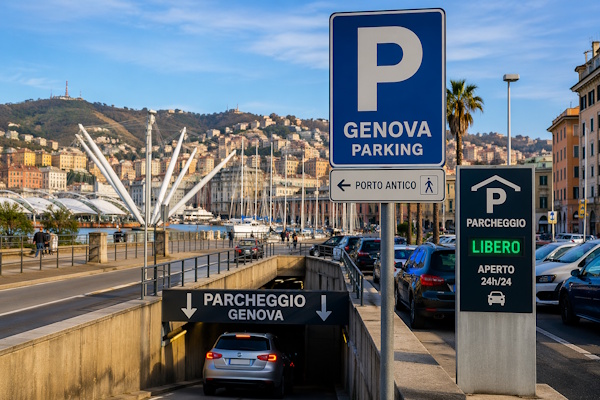
The good news is that parking in Genoa is manageable if you understand a few essential rules before you arrive. The most important things to know are the ZTL, the blue parking system, the difference between free and paid spaces, and the fact that motorway tolls on the way into Genoa are separate from city driving restrictions. Genoa’s official tourism information says the historic center is protected by a ZTL where driving through and parking are prohibited for non-residents, while outside the ZTL parking is regulated by the “Blu Area” system with blue pavement markings.
This guide is written for tourists who want a practical explanation in plain English. It covers where to park, what the blue and white markings mean, whether there is a toll in Genoa, how restricted traffic zones work, what to expect near the port and cruise terminals, and when it makes sense to reserve a garage in advance instead of searching on the street.
>>> Compare and reserve parking in Genoa here
Why parking in Genoa is harder than many tourists expect
Genoa is not a city designed for easy modern driving. It grew around a medieval port and a dense old town, and large parts of the city center are difficult to navigate by car. Many visitors come expecting a normal downtown with clear wide roads and lots of public garages close to the main sights. In reality, Genoa’s historic center is protected by a ZTL, and the city advises visitors that a car is not necessary for sightseeing because of the public transport network and the numerous public car parks outside the most sensitive areas.
That does not mean driving to Genoa is a bad idea. It simply means you need a plan. If you are arriving for a cruise, a ferry, a hotel stay outside the center, or a larger Liguria road trip, driving can make perfect sense. If your main goal is to walk around Porto Antico, visit the old town, see the aquarium and spend the day in the center, then the best strategy is usually to park once and leave the car there.
For many travelers, Genoa is not the final destination but part of a larger itinerary. You may continue to Cinque Terre, Manarola, Vernazza, Riomaggiore, Rapallo or other parts of Liguria. In that kind of trip, safe parking in Genoa becomes especially important because you want to avoid wasting time with fines, towing or confused city driving.
What does ZTL mean in Genoa?
The first term every tourist should learn is ZTL, which stands for “Zona a Traffico Limitato,” or limited traffic zone. In Genoa, as in many Italian cities, this is a restricted area where only authorized vehicles may enter. Official Genoa tourism information states clearly that driving through and parking in the ZTL is prohibited for non-residents. A Parclick support article about Genoa’s ZTL says the city has seven ZTLs that are active every day of the year, 24 hours a day, with one night-only area among them.
For first-time visitors, the most important practical point is simple: do not assume you can drive into the old center just because your navigation app sends you there. Camera controls can record unauthorized vehicles, and the result may be a fine that arrives long after your trip. The same basic risk exists in cities like Florence, Rome and Milan, but Genoa can be even trickier because the city layout is less intuitive for visitors and several sensitive areas are close to the port and the old center.
If you are staying at a hotel inside the ZTL, or using a garage in a restricted area, ask in advance whether they can authorize your vehicle. Never rely on guesswork. If you are not absolutely sure, choose parking outside the ZTL and continue on foot, by metro or by bus.
>>> Compare and reserve parking in Genoa here
Does Genoa have a city toll?
This is a common question among tourists, especially travelers from the US who may be used to bridge tolls, express lanes or city access charges. Genoa does not have a normal city toll in the usual tourist sense. The bigger issue is the ZTL, not a city-center congestion fee. If you drive into a restricted zone without authorization, that is a violation, not a routine toll payment.
However, you may well pay tolls on the way to Genoa. If you drive on Italian autostrade, you normally pay motorway tolls based on distance, vehicle class and route characteristics. Autostrade per l’Italia explains that tolls are calculated from the number of kilometres travelled, the applicable unit rate, the type of vehicle and the characteristics of the route, with VAT added and then rounded to the nearest 10 euro cents.
In practical terms, this means:
- You may pay tolls when driving to Genoa on Italian motorways.
- You do not usually pay a standard “Genoa city toll” to enter downtown.
- You can still be fined if you drive into the ZTL without authorization.
So if someone asks whether Genoa has a toll, the most accurate tourist answer is: motorway tolls yes, city-entry toll no, ZTL fines possibly.
What do the parking colors mean in Genoa?
This is one of the most important topics for tourists with little Italy driving experience. In Genoa, the parking color system matters. A local English-language PDF about Genoa’s parking areas explains that parking areas are divided into white areas and blue areas. White areas are free parking spaces, while blue areas are paid parking spaces. The same document also explains that within the blue system there are resident areas and “Isola Azzurra” areas for paid parking for all, marked with the letter P. Official Genoa tourism information also states that outside the ZTL parking is regulated by the “Blu Area” system, identified by blue pavement markings.
Blue parking spaces in Genoa
Blue-marked parking spaces are the ones tourists will notice most often. These are paid spaces. But in Genoa the blue system is not always as simple as “blue equals paid for everybody.” Some blue areas are linked to residents, and some are open paid areas for all users. The local PDF explains that the “Zona Residenti” is marked with letters from A to M and is free for residents, while “Isola Azzurra” is paid parking for all and is marked with the letter P. This means tourists must look not only at the painted lines but also at the sign.
That detail is easy to miss if you are used to simpler parking rules. A blue line alone is not enough information. Always check whether the sign refers to residents, paid public use, hours of operation, or any local exceptions. If you cannot confidently understand the sign, it is safer to move on or use a garage.
White parking spaces in Genoa
White spaces are generally free parking spaces. That sounds attractive, but tourists should be realistic. Free street parking near the most useful central areas is limited and can be very hard to find. You should also make sure that there are no additional signs that restrict time or user category. In a busy city like Genoa, a “free” white space in a convenient location is usually either already occupied or not ideal for a visitor who wants a stress-free arrival.
Yellow and reserved spaces
The sources gathered here focus mainly on Genoa’s white and blue systems, but as in the rest of Italy, visitors should assume that yellow or specially marked spaces are reserved for disabled permit holders, loading zones or other authorized users. If a space is clearly marked for a special category, do not use it unless you qualify. This is one of those basic rules that can save you money and trouble.
What is the Blu Area system in Genoa?
The official city tourism page mentions the “Blu Area” system as Genoa’s standard street-parking system outside the ZTL. The local PDF gives more detail and shows that the Blu Area is divided into categories, including resident zones and “Isola Azzurra” public paid zones marked with the letter P.
For tourists, this matters because street parking in Genoa is not just a question of “free or paid.” It is also a question of whether a given blue-marked space is designed mainly for residents or for general paid parking. If you find a street space, read the sign carefully. Look for:
- Whether the area is for residents only
- Whether visitors may pay and park there
- Applicable hours and rates
- Letter or zone codes shown on the sign
This is one reason many visitors prefer garages. Garages remove the need to decode local street rules after a long drive.
Is street parking in Genoa a good idea for tourists?
Sometimes, yes. Often, no. Street parking in Genoa can work if you know exactly what you are doing, understand the signs and do not mind walking or using public transport. But for many first-time tourists, especially Americans unused to Italian city parking, street parking is not the easiest choice.
Street parking may still make sense if:
- You are staying outside the old center.
- You know the neighborhood well.
- You only need a short stop.
- You are comfortable reading local parking signs.
It is usually a bad idea if:
- You arrive with luggage and want a simple experience.
- You are trying to park close to Porto Antico or the old center.
- You are worried about entering the ZTL by mistake.
- You have limited patience for circling narrow streets.
In those cases, a garage is usually a better solution.
Why garage parking is often the better option in Genoa
For most tourists, especially those with little experience driving in Italy, a garage offers the easiest and safest way to handle parking in Genoa. You know where you are going, you know the general cost in advance, and you reduce the chances of accidentally parking in the wrong place or entering a restricted area. Parclick’s Genoa listings highlight several advantages that matter to visitors, including covered parking, monitored facilities, flexible access and locations near train stations, the port and the city center.
Garages also make sense because Genoa is a city where a parked car is usually less useful than your own feet. Once you are in the center, walking is often the best way to explore. You may want to visit the Genoa Aquarium, stroll through the old town, see the port area, and then move on to restaurants or museums. Having the car safely parked lets you enjoy the city instead of worrying about tickets, meters and return times.
See current parking options in Genoa
Best areas to park in Genoa depending on your plan
Parking near the port, ferry terminal and cruise terminal
This is one of the strongest use cases for Genoa parking pages, because many travelers arrive by ferry or cruise or want to leave the car near the port. The Lanterna car park listed on Parclick is described as being about 200 meters from the ferry terminal, 1 kilometre from the cruise ship terminal and 1.5 kilometres from the Genoa highway exit. It also offers a free shuttle to the port docks, including Ponte dei Mille and Ponte Andrea Doria. That makes it especially useful for cruise passengers and ferry travelers.
If you are visiting Genoa as a port city, this kind of parking can be more practical than trying to squeeze into a central street spot. It is also a natural choice if you are combining a city stop with onward travel by ship.
Parking near Genoa Piazza Principe station
If your goal is to park and continue by train, or if you want easy access to the center without driving too deep into the city, parking near Piazza Principe can work very well. Parclick’s Genova Principe – Stazione car park is listed as being only a 3-minute walk from Piazza Principe station and close to the metro, making it a practical option for people who want station access and city transport connections.
This area is also useful if your hotel is near the station or if you are planning a rail connection to other Ligurian destinations.
Parking outside the busiest historic-center traffic
If you want to avoid the old center altogether, a parking option in an outer district can make your arrival much easier. The Dano Park – San Martino – Ospedale listing on Parclick explicitly says it is ideal if you need to park in Genoa outside the traffic of the historic center. It is covered, guarded and monitored, and the listing also notes that you need to leave the vehicle keys with staff.
For a tourist, this kind of outer-area garage can be a very sensible compromise: you avoid central confusion, but you still park in a controlled environment.
Parking near Genoa Aquarium and Porto Antico
Many tourists visiting Genoa want to spend most of their time in or near Porto Antico. This is logical because the waterfront area includes major attractions and is the part of the city many international visitors know best. If that is your plan, it is smart to choose parking that gives you easy access on foot or by public transport rather than trying to drive as close as possible to the attraction itself.
If Genoa Aquarium is on your list, you can start with our page on the Genoa Aquarium, then decide whether you want a port-area garage or a station-area garage with easy onward access. The old port area is busy, and trying to improvise in that part of town can easily waste time.
Is there free parking in Genoa?
Yes, in principle there are free spaces in Genoa, because the city has white parking areas. But this does not mean tourists should count on easy free parking near the center. White spaces are limited, competition is high, and central convenience is usually poor. In a dense city like Genoa, the cheapest option is not always the smartest option.
If your hotel is outside the core center, free or easier street parking may be more realistic. If you are making a short stop or visiting a less central neighborhood, you may be lucky. But if you are arriving for sightseeing in the old town or near the port, free parking is usually not worth building your plan around.
How expensive is parking in Genoa?
Parking costs in Genoa vary depending on location, parking type and whether you pre-book. Official tourism guidance says non-resident parking in Blu Area zones is costly and metered. Parclick presents Genoa parking as something that can be reserved in advance for hours, days or longer, and individual listings include central, station and port-related options with different service levels.
In practical terms, the cost of parking depends on questions like these:
- Do you want to park near the port or close to a station?
- Do you need only a few hours or several days?
- Do you want a covered monitored garage?
- Are you booking ahead or taking whatever is available on arrival?
For many travelers, the real saving comes not from finding the absolute cheapest option but from avoiding wasted time, ZTL fines and stressful city driving. If you are also planning other city stops in Italy, compare this with guides such as parking in Florence, parking in Milan, parking in Rome and parking in Venice. Genoa is not the easiest city, but it is often still less famous for parking stress than Florence or Venice, which is why many tourists underestimate it.
Should you reserve parking in Genoa in advance?
For most tourists, yes. Advance booking is especially useful in Genoa because the city has several very different visitor profiles. You might be arriving for a ferry, a cruise, a train connection, a hotel stay, a city break, or a larger Liguria road trip. In all of those situations, certainty has value.
Parclick’s Genoa pages emphasize advance reservation, guaranteed spaces and the ability to compare according to price, distance and services. That matters even more in a city where the difference between an easy arrival and a bad arrival can be one wrong turn into a restricted area.
Advance booking is particularly worthwhile if:
- You arrive at a busy weekend time.
- You have luggage.
- You need parking near the port or station.
- You are traveling with children.
- You do not want to interpret local signs after a long drive.
How long can you leave your car in Genoa?
This depends on the type of parking. Street spaces are usually best for short-term use, especially in busy urban areas where meters and local rules apply. Garages are more suitable for overnight stays, multi-day city visits, cruises, ferry trips and longer travel. Parclick’s general Genoa page explicitly presents parking options for hours, days, months or even years, which shows that the platform is designed for much more than quick daytime parking.
If you are leaving the car for several days while exploring Liguria or taking a cruise, choose a garage or monitored facility rather than street parking.
Driving into Genoa from the motorway: what tourists should know
If you drive into Genoa from outside the city, remember that the last part of the journey is usually the most stressful. Italian motorway driving is one thing; Genoa city driving is another. On the motorway, you mainly need to understand toll booths, lane choices and navigation. Once you leave the motorway near Genoa, the city becomes more compact and demanding.
The Lanterna parking listing is useful here because it notes that the garage is about 1.5 kilometres from the Genoa highway exit. That is exactly the kind of facility many tourists should prefer: easy enough to reach from the motorway, but close enough to the port and central attractions to stay practical.
What American tourists should avoid in Genoa
- Do not drive into the old center just because your phone says it is the shortest route.
- Do not assume blue lines always mean the same thing everywhere.
- Do not assume white spaces near the center will be easy to find.
- Do not confuse motorway tolls with city driving permissions.
- Do not expect large US-style downtown parking lots.
- Do not leave ZTL questions until the last minute.
Genoa rewards preparation. It punishes improvisation.
Is it better to visit Genoa without a car?
If Genoa is your only destination, many tourists would honestly be better off arriving by train and skipping the car entirely. Official city tourism information even says that a car is not necessary to explore the city’s attractions thanks to public transport and the availability of public car parks.
But many people visiting Genoa are not on a city-only trip. They are driving through Liguria, continuing to Tuscany, using the port, or traveling with family. In that case, the right answer is not “never drive to Genoa,” but “park smartly when you get there.”
A simple parking strategy for first-time visitors
- Decide first why you need parking in Genoa: sightseeing, cruise, ferry, hotel, station or road trip stop.
- Choose a garage that matches that purpose.
- Stay outside the ZTL unless you are absolutely sure your destination can legally handle your vehicle access.
- Once parked, continue on foot or by public transport.
This is the strategy with the lowest stress level and the best chance of keeping your trip simple.
What to do after parking in Genoa
Once the car is parked, Genoa becomes much easier to enjoy. You can explore the port, walk into the old town, visit the cathedral area, or spend time at Porto Antico. Depending on your interests, you may also want to continue your Liguria trip to Cinque Terre, La Spezia or Viareggio. If you are combining Genoa with other Italian city visits, our related guides on Florence parking, Rome parking, Milan parking and Trieste parking may help you plan the rest of the trip.
Final thoughts: is parking in Genoa difficult?
Yes, but not impossible. Genoa is difficult because of its urban structure, not because parking is unavailable everywhere. The real challenge is choosing the right kind of parking for your visit. If you understand that the ZTL is the main danger, that blue spaces are part of the regulated Blu Area system, that white spaces are free but limited, and that motorway tolls are separate from city restrictions, you are already ahead of many first-time visitors.
For cautious tourists, the safest answer is usually a reserved garage. For port users, a port-area facility such as Lanterna can make excellent sense. For train travelers, a station-area garage near Piazza Principe may be ideal. For nervous drivers, an outside-the-center garage can remove most of the stress immediately. Genoa is a city best enjoyed after you stop thinking about where to leave the car.
Compare Genoa parking options here
FAQ: Parking in Genoa
Is parking in Genoa difficult for tourists?
Yes, especially for first-time visitors. Genoa’s historic center is protected by a ZTL, and outside that area parking is regulated through the Blu Area system.
What do blue parking lines mean in Genoa?
Blue spaces are part of the city’s paid parking system. In Genoa, some blue areas are resident-related and others are public paid “Isola Azzurra” areas marked with the letter P, so visitors should always read the sign.
What do white parking lines mean in Genoa?
White spaces are generally free parking spaces. They exist, but in useful central areas they are limited and often difficult to find.
Does Genoa have a city toll?
Not in the normal tourist sense. You may pay motorway tolls on the way to Genoa, but the main city-center issue is the ZTL rather than a standard city toll.
Can tourists drive into Genoa’s historic center?
Normally no, unless they have specific authorization. Official tourism information says driving through and parking in the ZTL is prohibited for non-residents.
Where should cruise passengers park in Genoa?
A port-oriented facility is often the best solution. For example, Parclick’s Lanterna parking is described as being around 200 meters from the ferry terminal and 1 kilometre from the cruise terminal, with a free shuttle to the docks.
Is it worth reserving parking in Genoa in advance?
Usually yes. Booking ahead reduces stress, avoids wasted time and makes arrival easier, especially if you are visiting the port, a station or the city center.