Trieste: a practical guide to Italy’s Adriatic city
Trieste sits at the north-eastern edge of Italy, where the Adriatic meets the Karst plateau and the borders of Slovenia and Austria are close by. Its position has shaped the city’s architecture, food, languages and history. Trieste feels Italian, but its broad squares, grand waterfront buildings, coffee houses and Central European influences give it a character distinct from many other Italian cities.
This guide explains what to see in Trieste, how to plan a day or a longer stay, and how to reach the city and nearby sights. The city centre is manageable on foot, but attractions such as Miramare Castle and the Karst require extra time and transport planning. If you are visiting the wider region, our Friuli Venezia Giulia overview helps you connect Trieste with Aquileia, Grado, Udine and other destinations.
At a glance: Trieste is the capital of Friuli Venezia Giulia and a major port on the Adriatic. Piazza Unità d’Italia, the Grand Canal, San Giusto Hill and Miramare Castle are among its best-known places. One full day covers the central highlights; two or three days allow a more relaxed visit and a coastal or Karst excursion.
Why visit Trieste?
Trieste has an unusually layered history. It was part of the Habsburg lands for centuries and became a major port of the Austro-Hungarian Empire. After the First World War it became part of Italy. The city’s location near Slovenia and the wider Central European region has made it a meeting point for different communities and traditions. This history is visible in its churches, cafés, public buildings and everyday food culture.
The city is also a practical base for short excursions. Miramare Castle is a short distance from the centre, while the Karst landscape, coastal villages and the border area with Slovenia can be explored on day trips. Trieste suits travellers who enjoy architecture, literature, history, the sea and café culture more than those seeking a compact collection of blockbuster museums.
Main sights in Trieste
Piazza Unità d’Italia
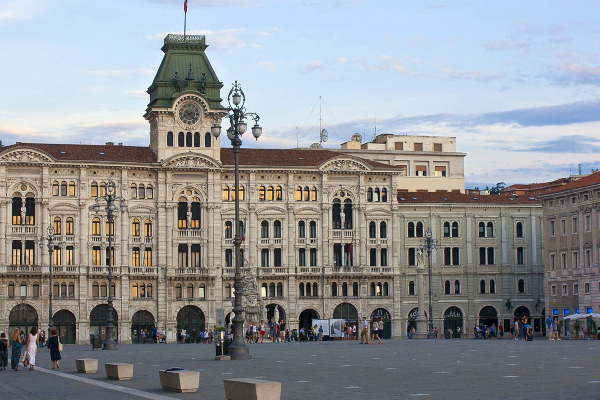
Piazza Unità d’Italia is the main civic square and one of the most striking open spaces in Trieste. It faces the sea, with monumental buildings on its other sides. The town hall, Palazzo del Governo and historic insurance company buildings create a grand setting, while the square’s open waterfront edge makes its orientation easy to understand. Visit in daylight to appreciate the architecture and return in the evening when the façades are illuminated.
The square is a good starting point for a walking route. From here, follow the waterfront, continue to the Molo Audace pier, then walk inland towards the Grand Canal. The sea-facing location can be windy, so a light layer is useful even when central streets feel warm.
The Grand Canal and Borgo Teresiano
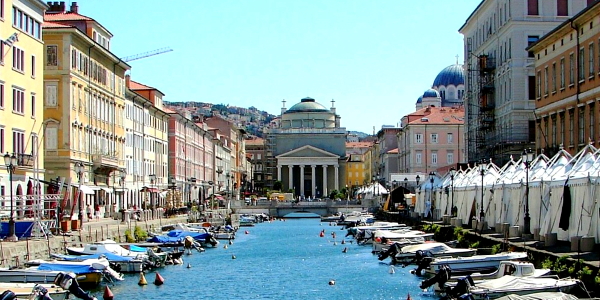
Trieste’s Grand Canal runs through the Borgo Teresiano district, an area planned during the Habsburg period. The canal is much smaller than Venice’s Grand Canal, but it is a pleasant urban landmark, framed by historic buildings and bridges. Piazza Sant’Antonio Nuovo is at its northern end, while the Church of Sant’Antonio Taumaturgo provides a strong architectural focal point.
The surrounding streets are good for a slow walk, a coffee stop or a meal. Look for the Serbian Orthodox Church of San Spiridione and the nearby Greek Orthodox Church of San Nicolò to understand the city’s long-standing religious diversity. These are active places of worship, so visitors should check access rules and be respectful during services.
San Giusto Hill and the cathedral
San Giusto Hill overlooks the historic centre and harbour. The cathedral combines different historical phases, and the nearby castle and Roman remains provide a compact introduction to Trieste’s long past. The climb from the lower town is manageable for many visitors but includes slopes and steps. If mobility is a concern, check local transport options and accessible routes before setting out.
The hill is also a useful viewpoint over the rooftops and port. Allow time to explore the cathedral and surrounding archaeological area rather than treating it only as a photo stop. Opening arrangements for religious buildings and museums may vary, particularly around services and holidays.
Miramare Castle and park
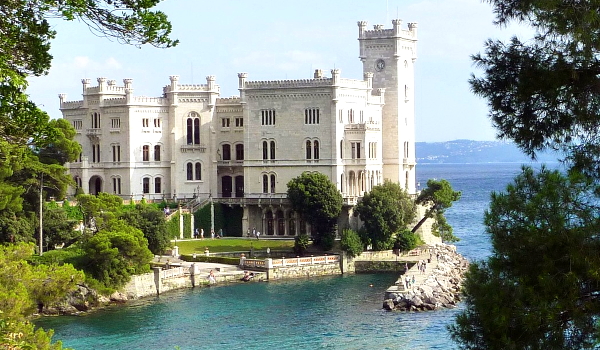
Miramare Castle stands on a promontory north of the city centre, with gardens descending towards the sea. It was built between 1856 and 1860 for Archduke Ferdinand Maximilian of Habsburg and his wife Charlotte. The interiors, park paths and coastal position make it one of the most popular excursions from Trieste. The official regional tourism site describes the castle and its extensive park; current access details should be checked before travelling. See the official Miramare Castle and park information.
Allow at least half a day if you want to visit the castle and walk through the grounds. The trip is straightforward by local transport, but the exact route and frequency can change. You can also walk along parts of the coast, though the terrain may be uneven. If visiting in high season, reserve or check entry arrangements for the interior separately from access to the park.
Roman Theatre and archaeological remains
The Roman Theatre is located near the centre, built into the slope below San Giusto Hill. It is an accessible reminder that Trieste, then Tergeste, was an important Roman settlement. The theatre is generally viewed from outside, while additional Roman remains and museum collections help give context to the ancient city. Combine it with the hill and cathedral for a route that spans several periods without requiring long travel.
Museums, cafés and literary Trieste
Trieste’s museums cover local history, art, science and the sea. Choose based on your interests rather than trying to visit several in a single day. The city is also associated with writers including James Joyce, Italo Svevo and Umberto Saba. Joyce lived in Trieste for several years, and the city’s cafés remain part of its identity. A coffee stop is not merely a break from sightseeing; it is one way to experience local urban life.
Coffee terminology can differ from what visitors expect elsewhere in Italy. If you are unsure, ask for the drink you want in simple terms. Take time to notice the historic interiors, but remember that popular cafés can be busy and that some have different prices for table service and counter service.
What to do in Trieste in one day
Begin at Piazza Unità d’Italia and walk along the waterfront to Molo Audace. Continue to the Grand Canal and Borgo Teresiano, stopping for coffee or a light meal. In the afternoon, visit the Roman Theatre and climb or travel up to San Giusto Hill. This route covers the central sights without adding Miramare, which deserves more time and is best treated as a separate half-day visit.
If you arrive early and walk at a brisk pace, you may be able to add a museum. Keep the day flexible if you want to explore the cafés and churches. Trieste is more rewarding when you allow pauses rather than trying to check off every sight.
Two or three days in Trieste
With two days, use the first for the city centre and San Giusto Hill, and the second for Miramare Castle and the coast. A third day can be used for a Karst excursion, a cave visit, a coastal walk or a trip across the border into Slovenia. Check opening hours and local transport for each individual attraction; routes that look close on a map may take longer because of terrain or limited services.
For a regional extension, consider Aquileia and Grado or Udine and Cividale. These destinations are not all convenient as casual add-ons to a single Trieste day, so choose based on your travel style and whether you have a car.
Getting to Trieste
Trieste is connected by rail and road to other northern Italian cities. The airport serving the region is located at Ronchi dei Legionari, outside the city; trains and bus services can connect the airport area with Trieste, but check current timetables and service changes before travel. Regional and long-distance rail connections vary, and some routes require a change.
For Slovenia, services can include buses and other cross-border connections, but frequencies depend on the route and date. Do not assume that every nearby Slovenian city has a direct train from Trieste. The official tourism service lists arrival and regional transport information, including public transport links. Check current arrival and transport options.
Getting around the city
The central area is walkable, though the city has steep streets and some attractions are uphill. Local buses are useful for longer distances, including the journey towards Miramare. Check the current operator route, ticket and validation rules. If travelling by car, study parking arrangements and any restricted traffic rules before driving into the centre. Parking in the historic core can be limited, and a hotel outside the centre may be easier if you need a vehicle.
Trieste is also a port city, so ferry and cruise arrangements may affect the waterfront at times. If you are arriving by cruise ship, check the distance between the terminal and the attractions you plan to visit and allow time for the return to the ship.
Food and drink in Trieste
Trieste’s food reflects the Adriatic, Friulian and Central European influences. Menus may include seafood, pasta, cured meats, soups and dishes with Austrian or Slavic connections. Local wine from the Karst and Friuli is widely available. A traditional buffet or osteria can offer a different experience from a seafood restaurant on the waterfront.
Ask about the daily menu and local specialties rather than relying only on generic tourist menus. If you have dietary requirements, explain them clearly. Seafood availability and prices vary, so check the menu before ordering. Coffee is a central part of local culture, and historic cafés are worth visiting for their atmosphere even if you do not stay long.
Where to stay in Trieste
Staying near the central station is practical for rail arrivals and day trips. The area around Piazza Unità and the Grand Canal is convenient for walking to major central sights, restaurants and cafés. Miramare is better as an excursion than as the only focus of a short city break, unless you specifically want a quieter coastal stay. Compare location, recent reviews and transport access before booking.
Find accommodation in Trieste
Compare hotels and guesthouses by the station, historic centre and waterfront, and check the walking distance to your planned sights.
When to visit Trieste
Spring and early autumn often suit city walks and day trips, though weather can change. Summer has longer days and a livelier coastal atmosphere, but popular places may be busy. Winter can be atmospheric and quieter, but wind and rain are possible. Trieste is known for the Bora, a strong north-easterly wind that can affect comfort and transport. Check forecasts before planning exposed coastal walks.
Choose the season according to your priorities: a beach trip, a city break or outdoor excursions. Some attractions and services adjust their hours seasonally, so verify them directly. There is no need to build the whole itinerary around one predicted weather pattern.
Plan a visit to Trieste and the region
Compare guided walks, museum visits and regional experiences for your dates. Check meeting points and what each offer includes.
Practical tips for visitors
- Wear comfortable shoes for slopes, cobbled streets and uneven paths around the coast.
- Allow extra time for Miramare Castle; it is outside the central walking area.
- Check train, bus and cross-border schedules shortly before travel.
- Carry a light windproof layer, especially near the sea and in the Bora season.
- Visit popular interiors early or check advance booking requirements.
- Respect religious sites and observe any service-time restrictions.
- If driving, check parking and restricted traffic rules before entering the centre.
Is Trieste worth visiting?
Trieste is worth visiting if you enjoy cities with a strong sense of place and a history shaped by several cultures. Its central sights are easy to combine on foot, while Miramare, the Karst and nearby destinations add variety. One day gives you a good introduction, but two or three days reveal more of the city’s cafés, museums and coastline.
For additional planning, see our Friuli Venezia Giulia region guide, and consider combining Trieste with Veneto if you are travelling west. For parking tips, read parking in Trieste.