 Posted by
 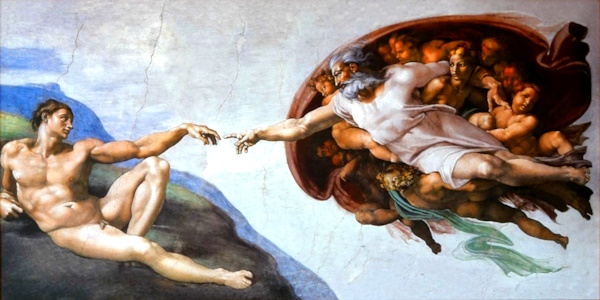 The image of the two almost-touching fingers has become recognizable far beyond the world of art. It has been reproduced in books, advertisements, films and popular culture countless times. Yet seeing the original in the Sistine Chapel is very different from seeing a reproduction.The Creation of Adam was painted around 1511 as part of Michelangelo’s enormous project to decorate the Sistine Chapel ceiling. The entire ceiling was completed between 1508 and 1512.Today the fresco is one of the main reasons millions of visitors enter the Vatican Museums every year. The Sistine Chapel forms part of the Vatican Museums visitor route, so you normally see The Creation of Adam as part of a visit to the museum complex.
Tickets for the Vatican Museums and Sistine Chapel
The Creation of Adam can be seen inside the Sistine Chapel, which is included in the Vatican Museums visit. Tickets can sell out during busy periods, especially in spring, summer and around major holidays.
Where is The Creation of Adam?
The original Creation of Adam is on the ceiling of the Sistine Chapel in Vatican City.
The Sistine Chapel is part of the Vatican Museums. Visitors cannot normally simply walk directly into the chapel from St. Peter’s Square. Instead, you enter through the Vatican Museums and follow the museum route until reaching the Sistine Chapel.
The chapel is located inside the Apostolic Palace and is famous not only for Michelangelo’s ceiling but also for his later masterpiece The Last Judgment, painted on the altar wall.
Anyone planning to see The Creation of Adam should therefore allow enough time for the Vatican Museums as a whole. The route passes through many galleries, rooms and collections before reaching the chapel.
Buy tickets for the Vatican Museums without queuing online: Click here
Who painted The Creation of Adam?
Michelangelo Buonarroti painted The Creation of Adam.
Michelangelo was born in 1475 and became one of the defining figures of the Italian Renaissance. He was a sculptor, painter, architect and poet, although he personally considered sculpture one of his principal artistic disciplines.
Among his most famous works are:
- David in Florence
- Pietà in St. Peter’s Basilica
- The Sistine Chapel ceiling
- The Last Judgment
- architectural work on St. Peter’s Basilica
His understanding of the human body is visible throughout the Sistine Chapel ceiling. Figures appear powerful, muscular and physically convincing, even when they represent biblical or supernatural beings.
Hotels in Rome near the Vatican
If the Vatican Museums and Sistine Chapel are among the main sights on your Rome itinerary, staying in or near the Vatican area can be convenient. You can compare hotels, guest houses and apartments in Rome on Booking.com.
When was The Creation of Adam painted?
Michelangelo worked on the Sistine Chapel ceiling between 1508 and 1512.
The Creation of Adam is generally dated to around 1511.
The project was commissioned by Pope Julius II and became one of the most ambitious artistic undertakings of the Renaissance.
The ceiling covers hundreds of square metres and contains a vast visual programme based largely on stories from the Book of Genesis.
Michelangelo did not simply paint one large continuous scene. Instead, the ceiling consists of numerous figures, architectural elements and biblical episodes arranged into a complex composition.
What does The Creation of Adam show?
The fresco depicts the moment in the biblical creation story when God gives life to Adam.
Adam lies on the earth on the left side of the composition. God approaches from the right, surrounded by figures and enclosed within a flowing form of fabric.
Both extend an arm towards one another.
The most famous detail is the tiny gap between God’s index finger and Adam’s finger.
They almost touch – but not quite.
That small space has become one of the most recognizable details in Western art.
The almost-touching fingers
The power of the scene comes partly from what Michelangelo does not show.
God and Adam are extremely close, yet their fingers remain separated by a narrow gap. This creates visual tension.
The viewer understands that the decisive moment is about to happen. Adam is on the verge of receiving life.
If Michelangelo had painted the fingers firmly touching, the scene would probably feel more static. By leaving a tiny space between them, he freezes the action immediately before its completion.
This gesture is usually interpreted as representing the transmission of life from God to Adam.
The image has become so famous that two hands reaching towards one another are now often understood as a reference to The Creation of Adam even when the original religious context is absent.
Meaning of The Creation of Adam
The basic theological meaning comes from the Book of Genesis.
God creates Adam and gives him life. Michelangelo transforms this biblical idea into a direct encounter between two human-like figures.
The image is therefore about creation, but it can also be read more broadly as an image of the relationship between humanity and the divine.
Adam appears physically complete, but he lacks the energy and force visible in God.
God moves dynamically towards Adam. Adam, by contrast, reclines on the ground and extends his hand with relatively little effort.
The contrast emphasizes their different roles: God is the source of life, while Adam receives it.
Adam’s body and pose
Adam is shown as a young, powerful male figure.
His body demonstrates Michelangelo’s extraordinary understanding of anatomy. The muscles, proportions and posture are carefully constructed, but the figure does not look rigid.
Adam’s pose is relaxed.
His left arm rests on his raised knee, while his right arm reaches towards God. His body appears heavy and connected to the earth.
This is particularly important to the composition. Adam already has the physical form of a human being, but he has not yet received the full spark of life.
Michelangelo therefore communicates the moment not through dramatic movement but through subtle differences in energy and posture.
God in The Creation of Adam
God appears on the right side of the fresco as an older, bearded man with a powerful body.
He is surrounded by several figures and moves rapidly through space inside a large flowing form.
His right arm extends towards Adam while his left arm surrounds or supports figures close to him.
The contrast between God and Adam is striking.
Adam seems calm and passive. God is energetic and purposeful.
This difference reinforces the central idea that the divine force is moving towards humanity.
Who is the woman next to God?
One of the most discussed details in The Creation of Adam is the female figure under God’s left arm.
Michelangelo did not provide a written explanation identifying every figure, so several interpretations have developed.
One common interpretation is that the woman represents Eve, who will later be created from Adam.
According to this reading, Eve already exists within God’s plan before her physical creation.
Other interpretations connect the figure with divine wisdom or with broader theological ideas.
Because no single interpretation can be proven beyond doubt, it is better to regard the identity of the woman as one of the interesting unresolved questions surrounding the fresco.
Does the shape around God look like a human brain?
One of the most famous modern theories about The Creation of Adam concerns the large red form surrounding God and the other figures.
Some researchers have argued that its outline resembles a cross-section of the human brain.
This idea has received considerable attention because Michelangelo had a strong knowledge of human anatomy. Like other Renaissance artists, he studied the human body closely.
If the resemblance was intentional, the image could suggest that God gives Adam not only life but also consciousness, intelligence or reason.
However, this remains an interpretation rather than a universally accepted fact.
Another theory compares the form to a womb, which would connect it even more directly to the idea of birth and creation.
These interpretations demonstrate how a seemingly simple composition continues to generate discussion more than five centuries after it was painted.
Buy tickets for the Vatican Museums without queuing online: Click here
Why is The Creation of Adam so famous?
There are many outstanding Renaissance paintings, but relatively few have become as instantly recognizable as The Creation of Adam.
Several factors explain its fame.
Simple composition
The central idea can be understood immediately.
Two figures face one another. Their hands stretch across an empty space. The viewer’s attention is naturally drawn to the fingers.
The scene therefore remains powerful even when reproduced at a small size.
Universal theme
The work depicts the creation of humanity.
Even viewers who do not approach the image primarily from a religious perspective can understand themes such as life, origin, human potential and the search for connection.
The gap between the fingers
Michelangelo created one of the most memorable visual devices in art history by leaving a small gap between the hands.
This gives the image movement and anticipation.
Michelangelo’s reputation
Michelangelo is one of the most famous artists in history. The Sistine Chapel ceiling represents one of his greatest achievements and one of the defining artistic projects of the Renaissance.
Is The Creation of Adam a painting or a fresco?
The Creation of Adam is a fresco.
Fresco painting involves applying pigments to freshly laid plaster. As the plaster dries, the colour becomes part of the wall or ceiling surface.
This technique requires careful planning because the artist can only work on the portion of wet plaster prepared for that day’s painting.
Painting a large fresco on a ceiling presented additional physical and technical challenges.
Did Michelangelo paint the Sistine Chapel lying down?
A popular story claims that Michelangelo painted the Sistine Chapel ceiling while lying flat on his back.
This is largely a myth.
Michelangelo worked on specially constructed scaffolding and generally painted while standing and looking upward.
The work was nevertheless physically demanding. Spending long periods painting above one’s head was uncomfortable and exhausting.
Michelangelo even wrote humorously about the physical strain caused by the project.
The Sistine Chapel ceiling
The Creation of Adam is only one scene within Michelangelo’s much larger Sistine Chapel ceiling.
The central section contains nine scenes from the Book of Genesis.
These include subjects connected with:
- the separation of light and darkness,
- the creation of the sun and moon,
- the creation of Adam,
- the creation of Eve,
- the Fall of Man,
- Noah and the Flood.
Around these central scenes Michelangelo painted prophets, sibyls, ancestors and numerous additional figures.
The result is not simply a collection of individual paintings. It is one enormous visual programme covering the ceiling of the chapel.
Where is The Creation of Adam on the Sistine Chapel ceiling?
The Creation of Adam appears in the central narrative sequence running along the main axis of the ceiling.
Visitors entering the Sistine Chapel can identify it by looking for the famous pair of reaching hands.
Because the ceiling is high above the floor, the actual fresco is farther away than many first-time visitors expect.
Details that appear enormous in photographs can look surprisingly small when viewed as part of the entire ceiling.
This is one reason it is useful to familiarize yourself with the main scenes before visiting.
How big is The Creation of Adam?
The fresco is approximately 4.8 metres by 2.3 metres.
That sounds large, but inside the enormous Sistine Chapel and among the many surrounding paintings, the work can initially appear less dominant than expected.
Its fame is therefore not primarily due to enormous dimensions. Its power comes from the composition and the relationship between the two central figures.
Can you photograph The Creation of Adam?
Photography rules inside the Sistine Chapel are strict.
Visitors should follow the current instructions of the Vatican Museums staff and the signs inside the chapel. Rules can change, and enforcement is generally stricter here than in many other parts of the museum.
The Sistine Chapel is also a functioning religious space, so visitors are expected to behave respectfully.
How long should you spend in the Sistine Chapel?
The amount of time varies considerably.
If you simply want to identify The Creation of Adam and The Last Judgment, a short visit may be sufficient.
However, the chapel contains so much detail that spending at least 15 to 30 minutes looking carefully at the ceiling and walls is worthwhile when visitor numbers permit.
The main problem is that the Sistine Chapel can be extremely crowded.
During busy periods, the experience can be less peaceful than photographs suggest.
Best time to visit the Sistine Chapel
The Vatican Museums are among the most visited attractions in Rome.
Visitor numbers are especially high during spring, summer, school holidays and around major religious events.
Booking a timed admission in advance is therefore strongly recommended.
An early entry can sometimes provide a more comfortable experience, although no specific time can guarantee an empty chapel.
Planning a Vatican visit?
The Vatican Museums are large, and the Sistine Chapel is reached near the end of the traditional museum route. Reserving admission before your visit can save time and reduce the risk of finding your preferred date sold out.
How to visit The Creation of Adam
To see the original fresco, you need to visit the Vatican Museums.
The normal process is:
- Enter the Vatican Museums through the museum entrance.
- Follow the museum route through the galleries.
- Continue towards the Sistine Chapel.
- Enter the chapel and look towards the central section of the ceiling.
Visitors should allow substantially more time than is required for the chapel alone.
A typical visit to the Vatican Museums can easily occupy several hours.
Can you visit only the Sistine Chapel?
For ordinary tourists, the Sistine Chapel is normally visited as part of the Vatican Museums rather than as a separate attraction with its own standard entrance ticket.
This means that people interested mainly in The Creation of Adam still pass through a substantial section of the museums before reaching it.
That is not necessarily a disadvantage. The Vatican Museums contain some of the most important collections of ancient sculpture, Renaissance art and papal history in the world.
What else should you see in the Vatican Museums?
If your main reason for visiting is Michelangelo, do not rush through everything else without looking.
Other major highlights include:
- Raphael Rooms,
- Gallery of Maps,
- ancient Roman and Greek sculptures,
- Pio-Clementine Museum,
- Sistine Chapel,
- Michelangelo’s Last Judgment.
The Vatican Museums can easily become overwhelming because of their size. It is therefore useful to identify a few priorities before entering.
The Creation of Adam and The Last Judgment
Visitors sometimes confuse Michelangelo’s two most famous works in the Sistine Chapel.
The Creation of Adam is on the ceiling.
The Last Judgment covers the large altar wall at one end of the chapel.
Michelangelo painted The Last Judgment much later, between 1536 and 1541.
The two works therefore belong to different stages of his career.
The Creation of Adam is balanced and relatively calm. The Last Judgment is much more crowded, dramatic and intense.
Michelangelo’s knowledge of anatomy
One of the reasons the figures in the Sistine Chapel are so convincing is Michelangelo’s deep understanding of the human body.
He studied anatomy closely and translated this knowledge into both sculpture and painting.
Adam’s body in The Creation of Adam resembles a monumental sculpture translated into fresco.
The muscles are carefully defined, yet the pose remains natural.
God and the surrounding figures also possess unusually powerful bodies for a religious painting.
This physicality is characteristic of Michelangelo’s style.
Why Adam looks almost passive
One of the most interesting aspects of the painting is Adam’s apparent lack of energy.
His arm is extended, but his wrist and hand remain relaxed.
God’s hand, by comparison, is active and deliberate.
This difference is usually understood as intentional.
Adam possesses a body but has not yet fully received the force that will animate him.
Michelangelo therefore depicts the difference between existence and life through body language rather than through a literal supernatural effect.
The empty space between God and Adam
The empty area between the two figures is one of the most important parts of the entire composition.
There is almost nothing there – just a small gap between the hands.
Yet that empty space contains the entire dramatic focus of the fresco.
The viewer anticipates contact.
This is one reason the work remains so effective after more than 500 years. The composition is simple enough to understand immediately but complex enough to support many interpretations.
Influence on modern culture
The two hands from The Creation of Adam have been reproduced and parodied thousands of times.
They appear in advertising, political cartoons, films, album covers, internet memes and contemporary art.
Sometimes God or Adam is replaced by another figure or object while the characteristic almost-touching fingers remain recognizable.
Few Renaissance works have had such an extensive influence on modern visual culture.
Restoration of the Sistine Chapel frescoes
The Sistine Chapel frescoes underwent a major restoration during the late 20th century.
Centuries of smoke, dirt and previous interventions had altered their appearance.
Cleaning revealed much brighter colours than many viewers and scholars had expected.
The restoration generated debate, but it fundamentally changed modern understanding of Michelangelo as a painter.
Today visitors see colours that appear much more vivid than in older photographs of the chapel.
Is The Creation of Adam Michelangelo’s greatest work?
There is no objective answer.
The Creation of Adam is certainly one of his most famous works, but Michelangelo produced several masterpieces that could compete for that title.
His David in Florence is one of the world’s most famous sculptures.
The Pietà in St. Peter’s Basilica is another extraordinary work.
The entire Sistine Chapel ceiling can also be considered as one artistic achievement rather than a collection of separate masterpieces.
For many visitors, however, The Creation of Adam is the single image they most strongly associate with Michelangelo.
Is The Creation of Adam the most famous painting in Rome?
It is certainly one of the strongest candidates.
Rome and Vatican City contain an enormous concentration of important art by Michelangelo, Raphael, Caravaggio and many other artists.
But few individual images are as internationally recognizable as the hands of God and Adam.
For us, seeing the original ceiling of the Sistine Chapel is one of the major artistic highlights of a trip to Rome and the Vatican.
Practical tips for seeing The Creation of Adam
- Book the Vatican Museums in advance: popular time slots can sell out.
- Allow several hours: the Sistine Chapel is only one part of a very large museum complex.
- Look up before entering: familiarize yourself with the position of The Creation of Adam so you can identify it quickly.
- Expect crowds: the chapel is one of the busiest rooms in the Vatican Museums.
- Follow photography rules: obey current signs and instructions from museum staff.
- Dress appropriately: the Sistine Chapel is a religious site and Vatican dress requirements apply.
- Do not rush: look at the entire ceiling rather than only the famous fingers.
Frequently asked questions about The Creation of Adam
Who painted The Creation of Adam?
Michelangelo Buonarroti painted The Creation of Adam as part of the Sistine Chapel ceiling.
When was The Creation of Adam painted?
The fresco is generally dated to around 1511. Michelangelo worked on the Sistine Chapel ceiling between 1508 and 1512.
Where is The Creation of Adam?
The original fresco is on the ceiling of the Sistine Chapel in Vatican City.
Which museum contains The Creation of Adam?
The Sistine Chapel forms part of the visitor route through the Vatican Museums.
What does The Creation of Adam represent?
It represents the biblical creation of Adam and the moment in which God gives life to the first man.
Why do God’s and Adam’s fingers not touch?
The small gap creates tension and emphasizes the instant immediately before Adam receives the divine spark of life.
Who is the woman next to God?
Her identity is debated. One common interpretation identifies her as Eve waiting to be created, although other interpretations exist.
Is there a hidden brain in The Creation of Adam?
Some researchers have argued that the form surrounding God resembles a human brain. It is an interesting and popular theory, but it cannot be treated as a proven explanation of Michelangelo’s intention.
How large is The Creation of Adam?
The fresco measures roughly 4.8 metres wide by 2.3 metres high.
Is The Creation of Adam an oil painting?
No. It is a fresco painted onto the ceiling of the Sistine Chapel.
Did Michelangelo paint it lying on his back?
No. The popular image of Michelangelo lying flat while painting is largely a myth. He worked from scaffolding, generally standing and looking upward.
Can you take photographs of The Creation of Adam?
Visitors should follow the current photography rules inside the Sistine Chapel. Restrictions are stricter than in many other parts of the Vatican Museums.
Can you visit The Creation of Adam for free?
Normally you need admission to the Vatican Museums to reach the Sistine Chapel. Special free-admission dates or other arrangements may exist, but these tend to attract particularly large crowds.
Can I buy a ticket only for the Sistine Chapel?
The Sistine Chapel is normally visited as part of the Vatican Museums rather than through a separate standard sightseeing ticket solely for the chapel.
How long does a Vatican Museums visit take?
Visitors commonly spend several hours inside. The exact duration depends on how many galleries and collections you want to see.
What other Michelangelo work is in the Sistine Chapel?
Michelangelo also painted The Last Judgment on the altar wall of the chapel several decades after completing the ceiling.
Conclusion: Why The Creation of Adam is worth seeing
The Creation of Adam is much more than an image of two famous hands.
Michelangelo transformed a short moment from the biblical Book of Genesis into one of the most powerful visual representations of creation ever produced.
The composition is remarkably simple. Adam lies on the earth. God moves towards him. Two arms extend across an empty space and the fingers almost meet.
Yet within that small gap Michelangelo created an image capable of expressing life, divine power, human potential and the relationship between humanity and its creator.
The fresco also demonstrates Michelangelo’s extraordinary understanding of the human body. Adam looks almost sculptural, while God and the surrounding figures possess the muscular physicality typical of Michelangelo’s work.
Seeing a reproduction does not fully prepare you for the original setting. The Creation of Adam is only one part of an enormous ceiling covered with biblical scenes, prophets, sibyls and monumental figures.
For that reason, visitors should not enter the Sistine Chapel, find the famous fingers and immediately leave. Take time to look at the entire ceiling and understand how The Creation of Adam fits into Michelangelo’s much larger artistic programme.
For art lovers, the Vatican Museums and Sistine Chapel are among the essential attractions of Rome. The Creation of Adam is one of their undisputed highlights.
All information Vatican Museum
Vatican Museums Overview
Pinacoteca of the Vatican
The Sistine Chapel
The Creation of Adam fresco
The Last Judgement
Rooms of Raphael
Pio Clementino Museum
The Torso from the Belvedere
Laocoon
The Gallery of Maps
The Carriage Museum of the Vatican